
Food · Local Classics
What Is Saimin? Hawaiʻi’s Noodle Soup and Where to Eat It
Saimin is Hawaiʻi’s own noodle soup: soft, curly wheat noodles in a light dashi, topped with char siu, fish cake and green onion. The word was in Honolulu newspapers by 1908. This guide explains what is in the bowl, how it differs from ramen and what the record shows about where it started, then lists five Oahu counters that showed as open on October 25, with hours and prices as each one posts them.
Some links on this page are affiliate links. If you book or buy through them, we may earn a commission at no extra cost to you.
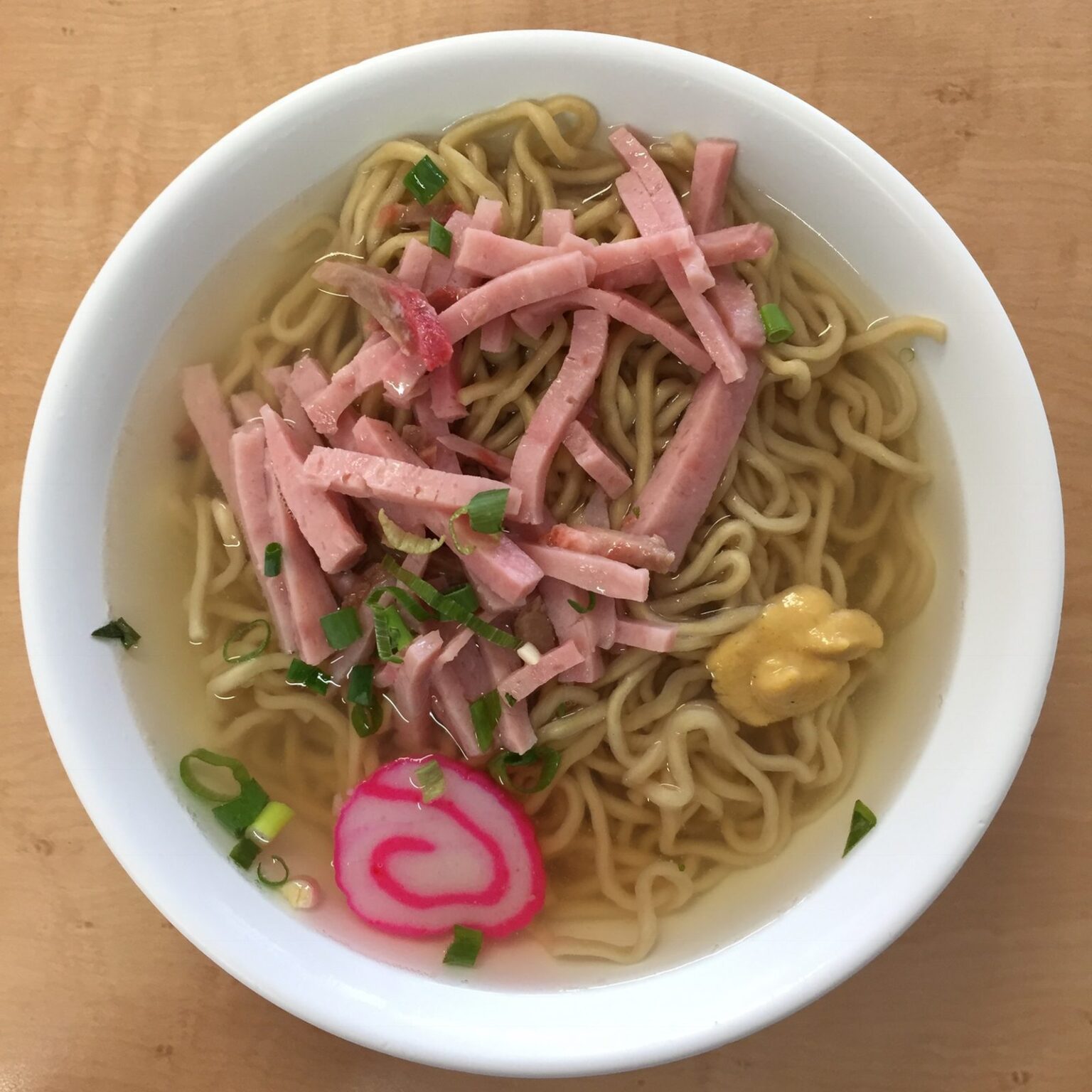
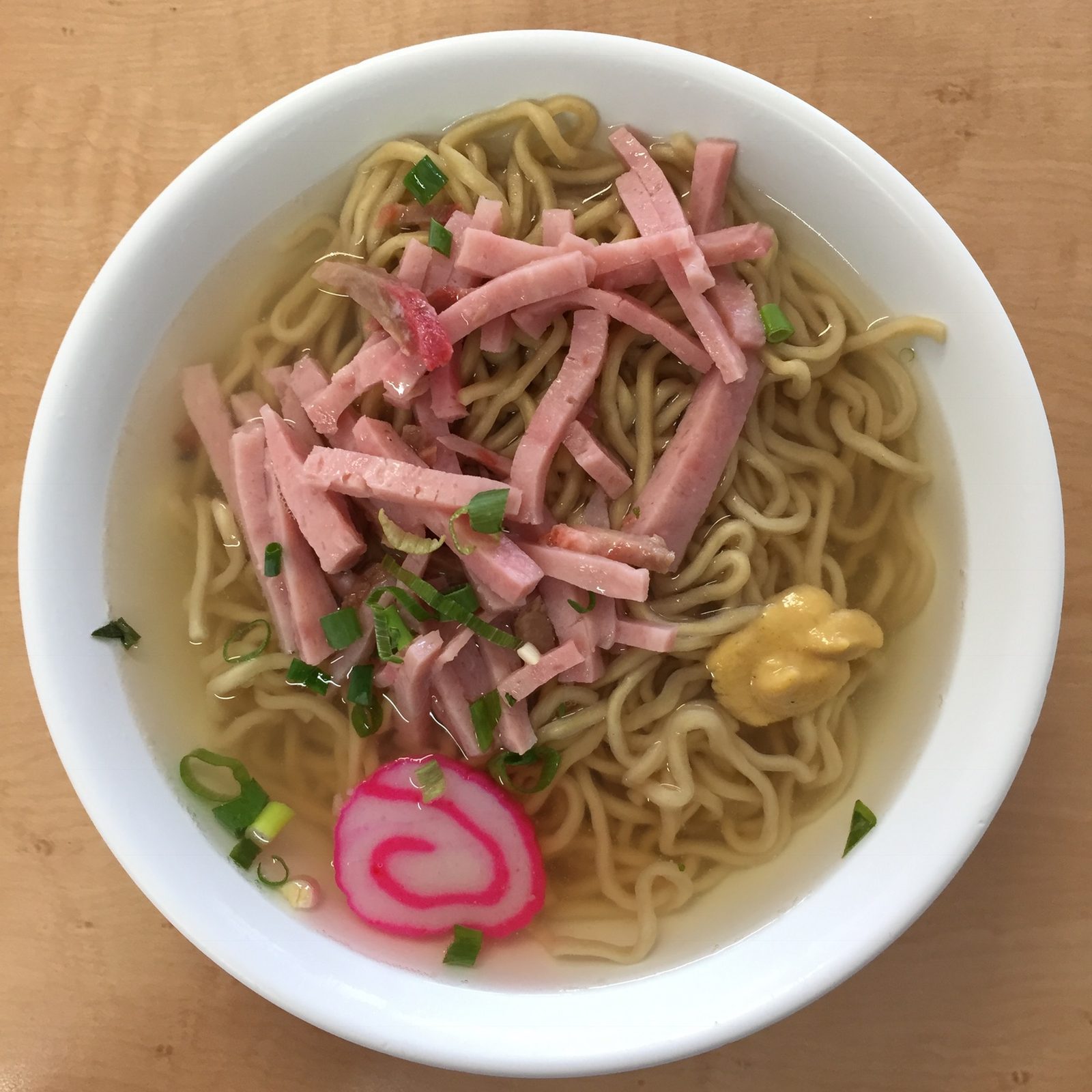
A small saimin with Spam, fish cake, green onions and a dab of hot mustard. Photo: Honolulu Noodz, CC BY-SA 4.0, via Wikimedia Commons.
Quick Answer
Saimin is a noodle soup from Hawaiʻi: curly wheat noodles in a clear dashi with toppings such as char siu, fish cake and green onion. It is not ramen, and the first Honolulu newspaper mention we found is from July 1908. Small bowls run $5.85 to $7.00 at the four places below that post a price. If you want noodles made that morning, go to Shige’s in Wahiawā or Shiro’s in ʻAiea.
What Is Saimin?
Saimin is a noodle soup made in Hawaiʻi and eaten at counters from Wahiawā to Kalihi. Zippy’s, which sells it across Oahu, puts it this way on its own Saimin Says page: “Saimin is a noodle dish that is unique to Hawaii and was created during the sugar and pineapple plantation era.”
The name is usually traced to two Chinese words, sai (thin) and min (noodle), according to HAWAIʻI Magazine. Hidehito Uki, president and CEO of Sun Noodle, told the magazine in 2019: “There is no saimin in Japan or China. This is truly a Hawaiʻi product.” The traditional Hawaiian food guide and our local Hawaiian snacks list cover the other island staples that sit beside it.
What Is in a Bowl of Saimin?
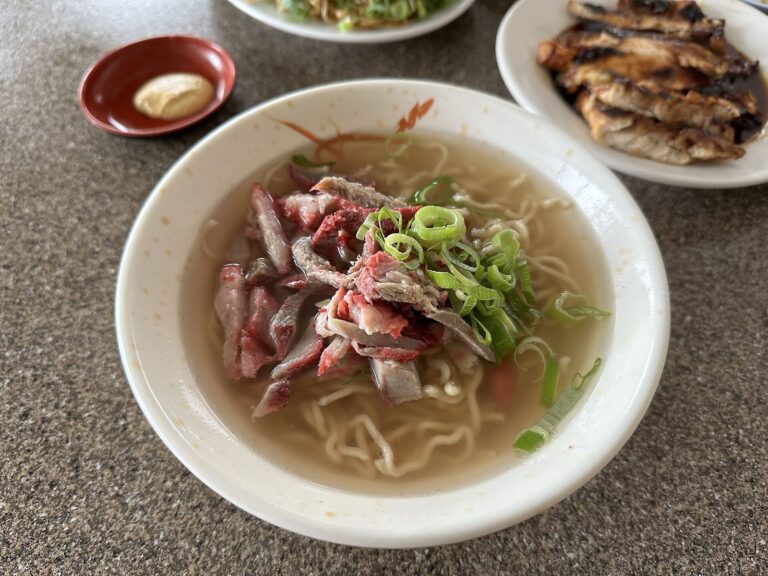
HAWAIʻI Magazine describes the noodles as curly, darker than ramen noodles and slightly chewy, and the broth as a hot dashi usually made from shrimp, mushrooms, ginger and konbu (dried kelp). Classic toppings are char siu (sweet roast pork), Spam, scrambled egg, green onions and kamaboko (fish cake). Newer shops add wonton, bok choy, bean sprouts or daikon.
Each counter writes its own version. Palace Saimin lists “traditional curly noodles in our dashi broth,” garnished with green onions and char siu. Zippy’s serves its bowl with a piece of uzumaki fish cake, sweet char siu, egg and choi sum. Wonton min is saimin with pork-filled wontons added, and Palace marks it “Locals’ Favorite” on its menu. A skewer of barbecue or teriyaki beef on the side is the usual add-on: HAWAIʻI Magazine lists it as the common side, and Palace sells tri-tip BBQ sticks at $4.00 each.
How Is Saimin Different From Ramen?
Both are wheat-noodle soups, and the difference is in the noodle, the broth and the attitude.
- Noodles. Uki told HAWAIʻI Magazine that saimin shares ramen’s base ingredients (wheat flour, sodium and potassium carbonate, and salt), but the saimin noodle is curlier and darker.
- Broth. Writing about Shige’s in 2015, the magazine said the dashi “isn’t rich like the collagen-laden broth at local ramen shops or overly salty.”
- Attitude. Zippy’s calls saimin “ramen’s less trendy, more authentic cousin.” Chef Mark “Gooch” Noguchi, on the same page, puts it more bluntly: ramen is the trendy one, saimin is life.
Where Did Saimin Come From?
The common story is a plantation one. HAWAIʻI Magazine dates it to the late 1800s, when workers from different ethnic camps shared ingredients at meals, and Zippy’s says the dish was created in the sugar and pineapple plantation era. That account is hard to pin to a date, so here is what the printed record shows.
The earliest Honolulu newspaper mention we found is in the Sunday Advertiser of July 19, 1908, in a column on a Saturday night when sailors were in port: “In Chinatown the sailors invaded the restaurants and learned to eat saimin and other tasty Oriental dishes.” It was already a dish a newspaper expected readers to know. Our Chinatown guide covers the neighborhood today.
Seven years later the Honolulu Star-Bulletin of December 13, 1915 told of two young Japanese women who were driven from Aala Park by a police officer “simply because they were selling” saimin, under an ordinance about a month old that barred peddlers from the park. They left the mayor a letter signed H. Nakamura: “We want to sell saimin or Japanese soup at Aala park.” Saimin was a street food sold by Japanese vendors in Honolulu by then.
A 2019 paper by Midori Hino in Chinese Dietary Culture says saimin has been popular in Hawaiʻi for more than 100 years, began among Asian immigrant laborers on sugar plantations, and carries a Cantonese-sounding name but has been sold by Japanese as well as Chinese vendors. Residents, she concludes, now see it as local comfort food and care little about its ethnic origins. The SABR Baseball Parks Project adds that its popularity “increased broadly after it became the specialty fast food at Honolulu Stadium.”
Fast food took it further. McDonald’s restaurants in Hawaiʻi sold saimin until June 2022, when Hawaii News Now reported the item was discontinued because Okahara Saimin, its supplier of about 40 years, had closed.

Honolulu Off the Beaten Path Food Tour (Chinatown)
★★★★★ 5 · 830 reviews · From $150
Check AvailabilityWe may earn a commission if you book through this link, at no extra cost to you.
Where to Eat Saimin on Oahu
These five showed as open on Google Maps on October 25, 2026, and each has hours and a price from the operator’s own page or a dated news report. They are not ranked 1 to 5, because they answer different needs, and each is labelled with the one it wins on. Prices are as posted, before tax, and can change.
| Counter | Area | Hours as posted | Saimin price as posted | Pick it for |
|---|---|---|---|---|
| Shige’s Saimin Stand | Wahiawā | Tue to Sat, 10 a.m. to 9 p.m. (Hawaii News Now and Google, Nov 2026) | No current price found; call (808) 621-3621 | Noodles made that morning |
| Palace Saimin | Kalihi | Tue to Fri, 10 a.m. to 8 p.m.; Sat, 10 a.m. to 3 p.m.; closed Sun and Mon | $7.00 small, $8.00 large, $9.00 X-large | The 1946 counter |
| Shiro’s Saimin Haven | Waimalu, ʻAiea | Restaurant daily, 7 a.m. to 9 p.m. | Takeout menu: $5.85 small, $7.65 medium, $9.65 large | The widest menu, 64 versions |
| Forty Niner Restaurant | ʻAiea | Mon to Sat, 7 a.m. to 6 p.m.; Sun, 7 a.m. to 2 p.m. | Online menu: $6.50 small, $8.55 large, $10.95 Big Boy | Saimin from 7 a.m. |
| Zippy’s | Islandwide | Varies by location | $5.90 regular, $7.45 large | Easiest to find |
The Five Counters, One by One
The cards are numbered for reference, not ranked. Each has a Google Map beside it, except Zippy’s, which has restaurants across the island. The notes come from the operators’ own pages and the news stories linked in them.
Shige’s Saimin Stand
Ross and JoAnn Shigeoka opened Shige’s in Wahiawā on March 31, 1990, as Hawaii News Now reported in June 2026. Tuesday through Saturday they start at 5:30 a.m. and make the noodles fresh, which Ross puts at “roughly 3 to 4 hours.” JoAnn told the station, “Making noodles is a workout.” Ross’s grandparents, Fujimatsu and Yoshie Nakai, opened Nakai Saimin Stand in Haleʻiwa in the 1950s. HAWAIʻI Magazine reported in 2015 that the stand opened with saimin and barbecue beef sticks and quoted Ross: “To me, saimin is the ultimate comfort food.” Hawaii News Now and the stand’s Google listing both give Tuesday through Saturday, 10 a.m. to 9 p.m., closed Sunday and Monday. We found no current price list on an operator page, so we print no price. Wahiawā is also home to Dole Plantation.
Palace Saimin
Kame Ige, who emigrated from Okinawa in 1924, opened Palace in Kalihi in 1946 and named it for the Palace Theater down the street (its story page), and the house dashi is the same recipe today. The menu lists saimin at $7.00 small, $8.00 large and $9.00 X-large, wonton min from $9.25 and $4.00 tri-tip BBQ sticks (menu, read October 25; prices subject to change). It is open Tuesday to Friday, 10 a.m. to 8 p.m., and Saturday, 10 a.m. to 3 p.m., and closed Sunday and Monday (its contact page). There is a free lot next door. Call (808) 841-9983.
Shiro’s Saimin Haven
Franz Shiro Matsuo opened Shiro’s in 1969, and its history page says the menu now carries 64 saimin creations, including the Dodonpa, built with 10 garnishes. The homepage says the noodles “are made fresh daily” and are “never frozen, dehydrated, or imported.” The March 2026 takeout menu lists a small saimin at $5.85, a medium at $7.65, the “Big Brah” large at $9.65 and wun tun min at $10.15, plus 4.712% state excise tax; the Dodonpa is $20.85. The Waimalu restaurant is open daily, 7 a.m. to 9 p.m., with last seating at 8:45 (hours); call (808) 488-8824. A second Shiro’s is at 91-919 Fort Weaver Road in ʻEwa Beach.
Forty Niner Restaurant
Richard Kiyoshi Chagami, a 442nd Regimental Combat Team veteran, started the Forty Niner in 1947, and the Historic Hawaiʻi Foundation notes he served saimin among local favorites. Its site lists Monday to Saturday, 7 a.m. to 6 p.m., and Sunday, 7 a.m. to 2 p.m. The online ordering menu lists a small saimin at $6.50, a large at $8.55, a Big Boy at $10.95 and an oxtail saimin at $21.95, with a teri beef side at $5.95; online prices can differ from the counter. The Waikīkī Forty Niner at 445 Seaside Avenue lists no saimin on its online menu, so this is the ʻAiea restaurant to visit. Call (808) 484-1940.
Zippy’s
Zippy’s sells saimin at its restaurants around the island, and its own Saimin Says page backs the dish. The Oahu menu lists a regular at $5.90, a large at $7.45, a keiki bowl at $5.55 and wun tun min at $12.25, with “uzumaki fish cake, sweet char siu pork, egg, and choi sum” on the plain bowl. Prices may vary by location, and hours do too, so check the locations page. Zippy’s marks 60 years in 2026 (its anniversary page).
How to Order Saimin and Plan the Trip
The planning is mostly hours and which bowl to start with.
- Start with a small. Small bowls are $5.85 at Shiro’s (takeout menu), $5.90 at Zippy’s, $6.50 at the Forty Niner and $7.00 at Palace.
- Add wontons or a stick. Palace’s wonton min starts at $9.25 and its BBQ sticks are $4.00; Shiro’s wun tun min is $10.15 on the takeout menu; the Forty Niner lists a teri beef side at $5.95.
- Sunday and Monday are the hard days. Palace is closed both, and so is Shige’s.
- Call about prices. Palace’s menu says “Menu items and prices may vary,” and Zippy’s says prices vary by location. Palace charges 25 cents for each takeout container.
- Plan the drive. Wahiawā, Kalihi and ʻAiea are all easier by car; see renting a car on Oahu. The two ʻAiea counters are in Pearl Harbor’s neighborhood, so they pair with a Pearl Harbor visit.
- Compare the price with other meals. The cost of food in Hawaii guide puts these bowls next to plate lunches and restaurant meals.
- Want more than saimin? The Oahu food tour guide routes a day of local food by area, and the best food on Oahu lists the island’s other standouts.
- Beyond Oahu. On Kauaʻi, the James Beard Foundation’s archive calls Hamura Saimin Stand in Līhuʻe “one of the oldest and most famous saimin shops in Hawaii.”

Waikīkī Food Walk with Five Local Tastings
★★★★★ 4.9 · 154 reviews · From $107
Check AvailabilityWe may earn a commission if you book through this link, at no extra cost to you.
Saimin Questions
What is saimin?
Saimin is a noodle soup from Hawaiʻi: curly wheat noodles in a clear dashi broth, usually topped with char siu, fish cake and green onion. Zippy’s describes it as “a noodle dish that is unique to Hawaii” created in the plantation era.
Is saimin the same as ramen?
No. Sun Noodle’s Hidehito Uki told HAWAIʻI Magazine in 2019 that the two share base ingredients, but saimin noodles are curlier and darker, and he said “There is no saimin in Japan or China.” HAWAIʻI Magazine has also described a saimin dashi as not as rich as the broth at local ramen shops.
Where did saimin come from?
It is tied to Hawaiʻi’s sugar plantation era and to Chinese and Japanese immigrants. The earliest Honolulu newspaper mention we found is in the Sunday Advertiser of July 19, 1908, and a Honolulu Star-Bulletin story of December 13, 1915 shows Japanese vendors selling it at Aala Park. A 2019 paper by Midori Hino says residents now care little about its ethnic origins.
How much does saimin cost on Oahu?
As posted on October 25, 2026, a small bowl is $5.85 at Shiro’s (takeout menu), $5.90 at Zippy’s, $6.50 at the Forty Niner (online menu) and $7.00 at Palace Saimin, before tax. Large bowls are $7.45 to $9.65 at those places.
Where can I eat saimin on Oahu?
Five places we checked: Shige’s Saimin Stand in Wahiawā, Palace Saimin in Kalihi, Shiro’s Saimin Haven and the Forty Niner Restaurant in ʻAiea, and Zippy’s restaurants around the island.
What is the best saimin on Oahu?
It depends on what you want. Shige’s and Shiro’s both say they make their noodles fresh, Palace has served saimin since 1946, Shiro’s lists 64 versions, the Forty Niner opens at 7 a.m. and Zippy’s is the easiest to reach.
Does McDonald’s in Hawaii sell saimin?
It did for about 40 years, until June 2022, when Hawaii News Now reported it was discontinued after its noodle supplier, Okahara Saimin, closed. Zippy’s lists a regular saimin at $5.90.
Sources, checked Oct 25, 2026
- Saimin Says (Zippy’s)
- Oahu menu, saimin (Zippy’s)
- Locations (Zippy’s)
- Our story, celebrating 60 years (Zippy’s)
- How Hawaiʻi-Style Saimin is Making a Comeback (HAWAIʻI Magazine, Aug 26, 2019)
- Noodle Star: Shige’s Saimin Stand on Oahu (HAWAIʻI Magazine, June 22, 2015)
- Shige’s Saimin Stand: Wahiawa sweethearts keep a family noodle tradition rolling (Hawaii News Now, June 4, 2026)
- McDonald’s in Hawaii discontinues saimin (Hawaii News Now, June 29, 2022)
- The Sunday Advertiser, Honolulu, July 19, 1908, page 2 (Library of Congress)
- Honolulu Star-Bulletin, December 13, 1915 (Library of Congress)
- A History of Saimin Soup Noodle in Hawaii: Ethnic Marker or Local Identity? (Midori Hino, Chinese Dietary Culture, 2019)
- Honolulu Stadium (SABR Baseball Parks Project)
- Hamura’s Saimin Stand, America’s Classics (James Beard Foundation archive)
- Home (Palace Saimin)
- Menu (Palace Saimin)
- Our story (Palace Saimin)
- Location and hours (Palace Saimin)
- Home (Shiro’s Saimin Haven)
- Saimin menu and hours (Shiro’s Saimin Haven)
- Shiro’s history (Shiro’s Saimin Haven)
- Takeout menu, March 2026 (Shiro’s Saimin Haven, PDF)
- Home and hours (Forty Niner Restaurant)
- Online menu, Aiea (Forty Niner Restaurant)
- Online menu, Waikiki (Forty Niner Restaurant)
- Forty Niner Restaurant (Historic Hawaiʻi Foundation)
Researched from the sources above, checked Oct 25, 2026. We never claim a visit we did not make; first-hand notes are marked as Stew’s. How we research and review.

Leave a Reply