
Beaches · Waikiki
Waikiki’s Beaches, Section by Section
Waikiki Beach is really a string of beaches, from the Hilton Hawaiian Village lagoon to Kaimana Beach below Diamond Head. The sections differ more than the postcards suggest: some are lifeguarded and calm, one has almost no sand, and one is a protected marine district. Here is each stretch, west to east, with the hotels that front it and the day it suits.
Some links on this page are affiliate links. If you book or buy through them, we may earn a commission at no extra cost to you.
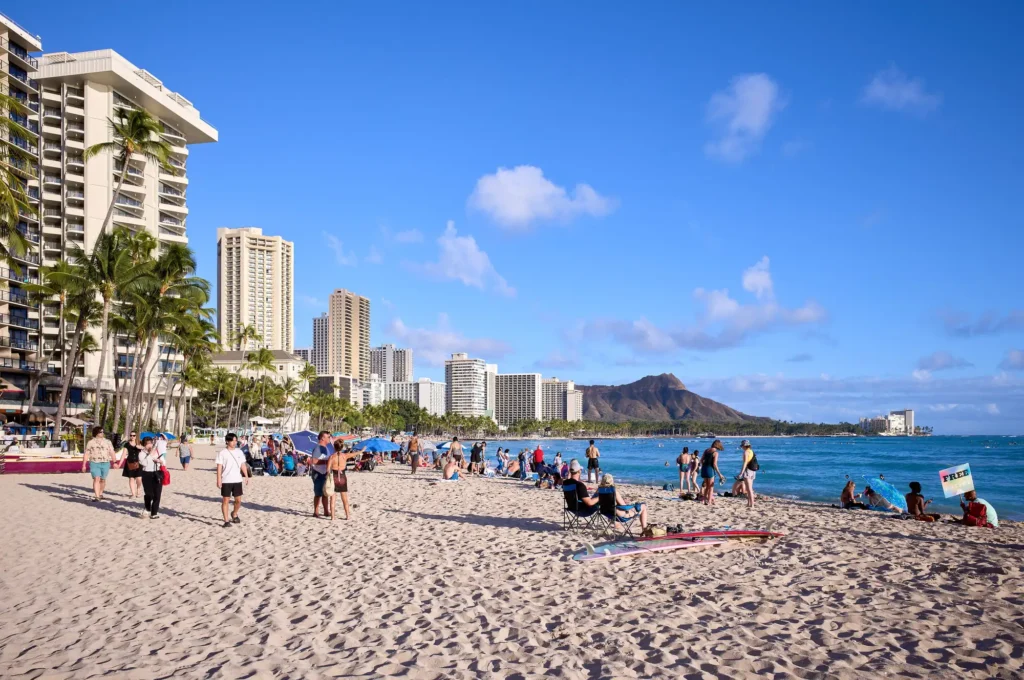
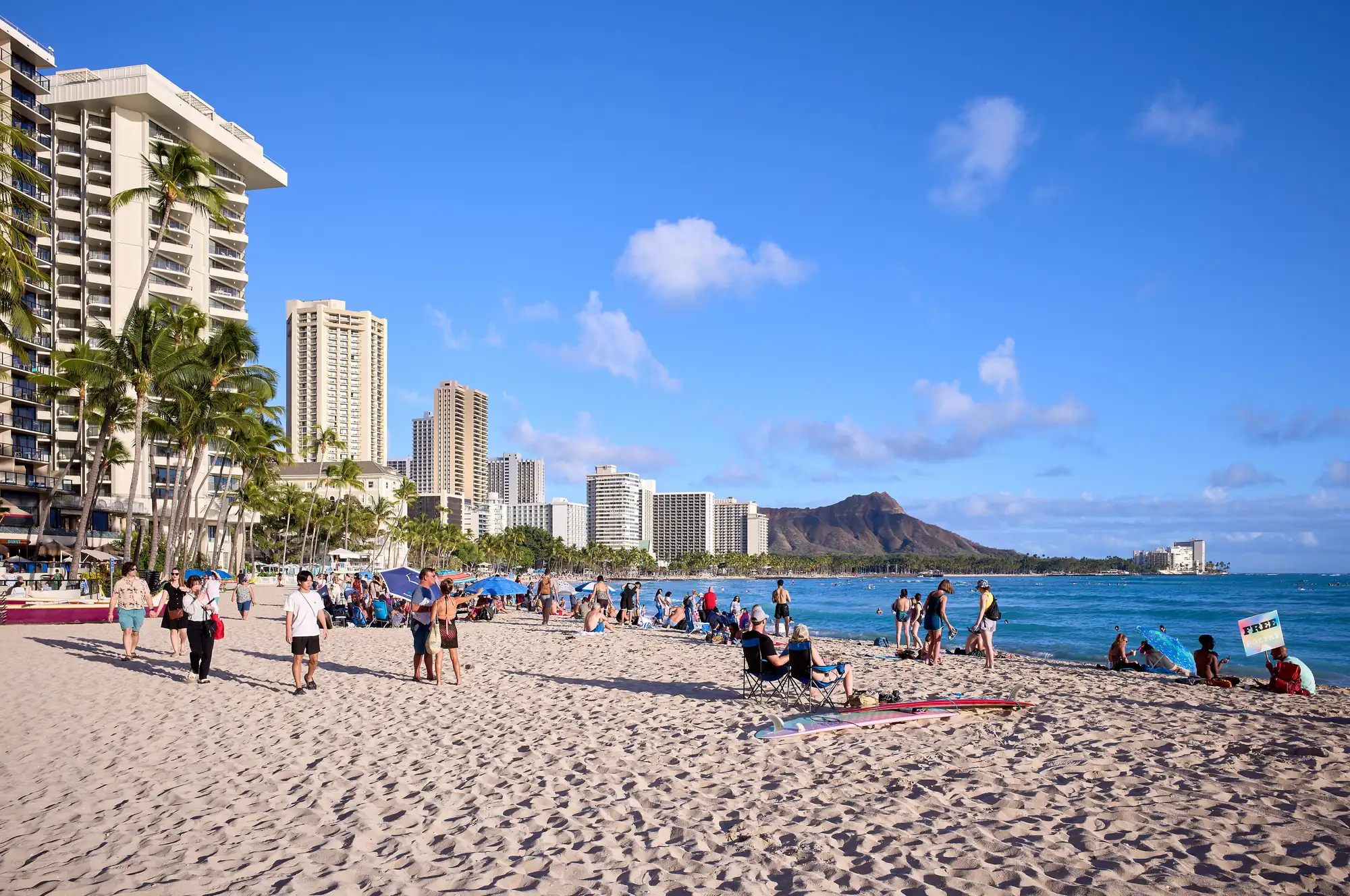
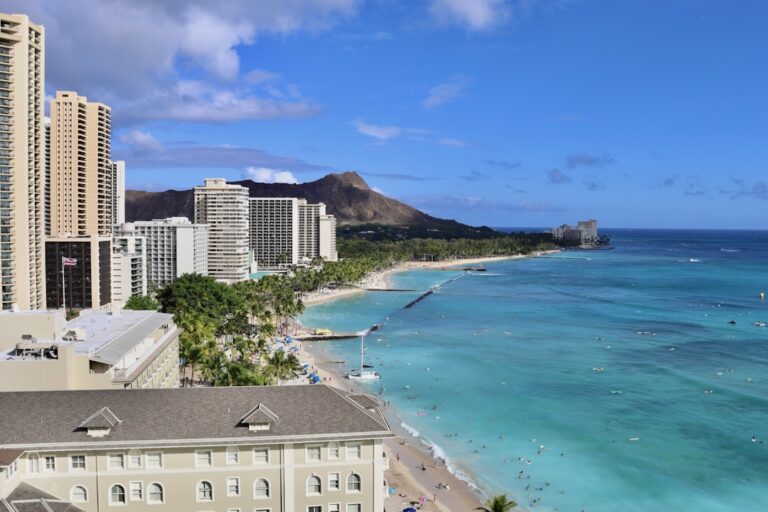
Waikiki Beach toward Diamond Head. Photo: Frank Schulenburg, CC BY-SA 4.0, via Wikimedia Commons.
Which stretch you land on depends mostly on your hotel, and the differences matter. The city’s lifeguard towers start at the Moana Surfrider and run east. West of there, the beaches are unguarded. The calmest water for small children is in the walled basin at Kuhio Beach, and the quietest swimming is at Kaimana, at the Diamond Head end.
Pick Your Stretch
The Best Waikiki Beach for Your Day
Small kids: Kuhio Beach Park’s walled basin, with four lifeguard towers. Quiet swim: Sans Souci and Kaimana Beach. Room to spread out: Fort DeRussy. A surf lesson: central Waikiki, where the schools launch. Fish: the reef off Kapiʻolani Park, inside the marine conservation district.
Waikiki Beach at a Glance
| Section | Fronts | Lifeguard tower | Water | Best for |
|---|---|---|---|---|
| Duke Kahanamoku Beach and Lagoon | Hilton Hawaiian Village | None listed | Calm man-made lagoon plus an ocean beach | Small kids in the lagoon |
| Fort DeRussy Beach | Hale Koa, Fort DeRussy Park | None listed | Wide sand, open ocean | Room to spread out |
| Grey’s Beach (Kawehewehe) | Halekulani, Sheraton Waikiki | None listed | Thinnest sand on the strip | A quick dip |
| Royal Hawaiian and Moana | Royal Hawaiian, Moana Surfrider | 2A | Busy sand beach, gentle surf | The classic Waikiki day |
| Kuhio Beach Park | Hyatt Regency and Kalakaua Ave hotels | 2B, 2C, 2DP, 2D | Walled, shallow swim basin | Families, hula show |
| Queen’s Surf and the Wall | Kapiʻolani Park’s west edge | Between 2D and 2E | Steep, narrow beach, small waves | Bodyboarding, people-watching |
| Kapiʻolani Park Beach | Kapiʻolani Park | 2E, 2F | Protected reef flat, fish | A quieter swim near the Aquarium |
| Sans Souci / Kaimana | Kaimana Beach Hotel | 2H | Shallow, sandy, no strong current | Calm swimming |
Tower numbers come from Honolulu Ocean Safety’s tower list. Towers are staffed 8 a.m. to 6:30 p.m. every day. Before you swim anywhere, our guide to whether it is safe to swim on Oahu today covers the warning signs and surf alerts.
Waikiki’s Beaches, West to East
Duke Kahanamoku Beach and Lagoon
In front of the Hilton Hawaiian Village. The 4.6-acre lagoon was dredged in 1955 and 1956 and reopened in 2007 after a renovation, and its still, shallow water is the calmest on the strip for toddlers. The ocean beach beside it is open water. The city lists no lifeguard tower on this stretch, so watch your own swimmers. Named for Duke Kahanamoku, the Olympic swimmer and father of modern surfing.
Fort DeRussy Beach
A wide, less crowded beach in front of a grass park and the Hale Koa hotel, on an Army recreation area. Like every beach in Hawaiʻi, it is open to the public. The sand is broad, with the park lawn behind it. No city lifeguard tower here either.
Grey’s Beach (Kawehewehe)
Between the Halekulani and the Sheraton Waikiki. The Hawaiian name, Kawehewehe, refers to a channel where Hawaiian royalty bathed in water believed to heal. Erosion has left this the narrowest stretch of sand on the strip, so it suits a swim more than a towel. The state’s restoration project for this section is still in planning.
Royal Hawaiian and Moana Surfrider
The stretch in front of the Royal Hawaiian, open since 1927, and the Moana Surfrider. This is the Waikiki most people picture: busy sand, gentle surf, surf schools launching boards. Tower 2A, at the Moana, is the westernmost lifeguard tower on the city’s list.

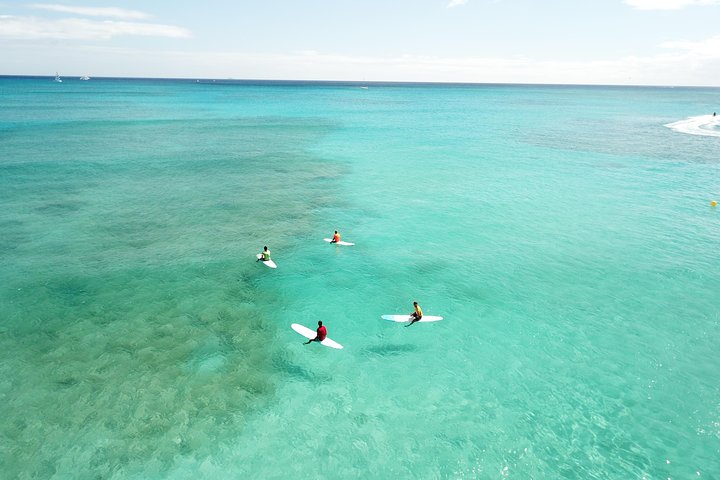
Outrigger Canoe Surfing off Waikiki Beach
★★★★★ 4.6 · 127 reviews · From $52
Check AvailabilityWe may earn a commission if you book through this link, at no extra cost to you.
Kuhio Beach Park
The walled swim basins along Kalakaua Avenue, behind a breakwater built in 1951. Inside the wall the water is calm and shallow, and four towers, 2B, 2C, 2DP and 2D, watch it. The Duke Kahanamoku statue and the hula mound are here.
Kuhio Beach
The Free Hula Show, and This Fall’s Sand Work
The Kuhio Beach Hula Show runs Saturday evenings, 6:30 to 7:30 p.m., weather permitting, on the hula mound near the Duke statue. It is free; bring something to sit on. A separate program, The Return of Kapaemahu, runs Wednesdays at the same time. Shows are canceled when Kalakaua Avenue is closed for a parade, and the schedule changes, so check it before you go. Source: the Hawaiʻi Tourism Authority listing.
The state conservation office lists a sand-nourishment project for the Kuhio swim basins starting in fall 2026: moving sand back to shore, widening the beach and replacing the sandbag groin with rock. Expect equipment or fencing on part of the beach while it runs.
Queen’s Surf and the Kapahulu Groin
The concrete groin at the east end of Kuhio Beach is the Wall, and the beach on its Diamond Head side is Queen’s Surf. The sand is steep and narrow, the waves are small, and it is bodyboarding territory rather than a snorkel spot. Ocean Safety warns against jumping off the Wall. Don’t confuse the beach with the Queen’s surf break, which is off Kuhio Beach.
Kapiʻolani Park Beach
From the Wall to the Natatorium, this stretch is inside the Waikiki Marine Life Conservation District, where taking fish or coral is prohibited. A reef flat runs out from the Aquarium’s seawall, under 3 to 4 feet of water, to an 8-foot channel. The fish gather along the channel, the Natatorium wall and the outer reef edge, which is dangerous in summer swell. Towers 2E and 2F.
Between here and Kaimana is the Waikiki War Memorial Natatorium, a saltwater pool closed to swimming since 1979. A rehabilitation is in planning. It is a landmark to see, not a place to swim.
Sans Souci / Kaimana Beach
Between the Natatorium and the Kaimana Beach Hotel. A wide reef keeps the water near shore shallow, sandy and free of strong currents, which makes this the calmest swimming at the Diamond Head end. Tower 2H. Hawaiian monk seals haul out here; a pup was born on this beach in May 2026. Stay 50 feet away, 150 feet from a mother and pup. Park in the Honolulu Zoo lot off Kapahulu Avenue, $1.50 an hour for up to 4 hours.
Just past Waikiki: Ala Moana Beach Park and Magic Island, to the west, are lifeguarded and a short ride away. The swimming area there is a dredged channel 20 to 30 feet deep behind an offshore reef, good for laps rather than wading. Our guide to the best beaches on Oahu covers it with the rest of the island.
Safety on Waikiki’s Beaches
- Read the signs. Oahu lifeguards post warning signs, not colored flags: rip current, high surf, sharp coral, jellyfish and others.
- Box jellyfish. They come to the south shore 9 to 10 days after the full moon. Check the Waikiki Aquarium’s box jellyfish calendar before you plan a swim.
- Rip currents. Swim parallel to shore until you are out of the pull, then angle back in. If you can’t, float and wave for help.
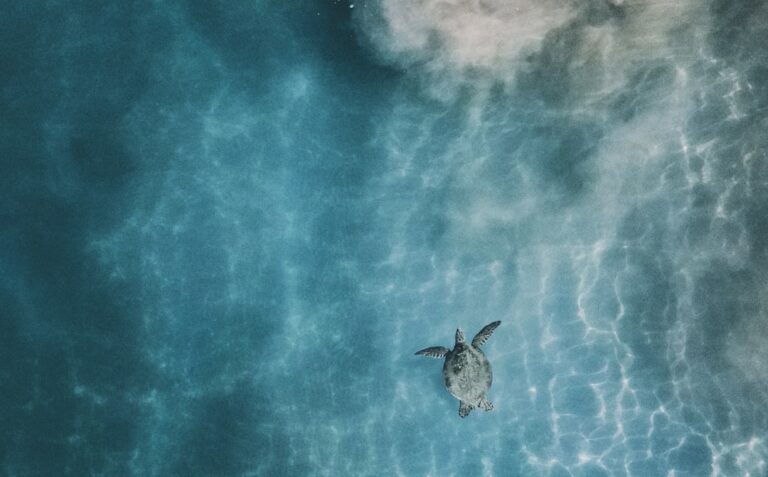
- Wildlife. Stay at least 10 feet from sea turtles, in the water and on the sand, and 50 feet from monk seals.
- Water temperature. Our Waikiki water temperature guide has the month-by-month numbers.
Want to be in the water rather than on it? Our Waikiki surf lessons comparison and the Waikiki surf map cover the breaks, and snorkeling on Oahu covers the reef off Kapiʻolani Park.
Book Your Stretch of Waikiki
Since the section you swim at mostly follows your hotel, pick the hotel by the beach you want. The Waikiki map shows where each hotel sits, and if you are still choosing between bases, see Ko Olina vs Waikiki.
Waikiki Beach Questions
Does Waikiki Beach have lifeguards?
Parts of it. The city staffs towers 2A to 2H from the Moana Surfrider east to Kaimana Beach, 8 a.m. to 6:30 p.m. daily. Its tower list shows none west of the Moana, which covers the Royal Hawaiian’s frontage, Grey’s Beach, Fort DeRussy and Duke Kahanamoku Beach.
Which part of Waikiki Beach is best for kids?
Kuhio Beach Park. Its walled swim basin is calm and shallow inside the breakwater, and four lifeguard towers watch it. The Hilton Hawaiian Village lagoon is calmer still, but the city lists no tower there.
When is the Kuhio Beach hula show?
Saturday evenings, 6:30 to 7:30 p.m., weather permitting, at the hula mound by the Duke Kahanamoku statue. It is free. A separate program, The Return of Kapaemahu, runs Wednesdays at the same time.
Can you swim at the Waikiki Natatorium?
No. The saltwater pool has been closed to swimming since 1979, and a rehabilitation is in planning. Swim at Kaimana Beach next door.
Is Kaimana Beach good for swimming?
Yes. A wide reef keeps the water near shore shallow, sandy and free of strong currents, and Lifeguard Tower 2H watches it. It sits outside the busiest part of Waikiki, below Diamond Head.
What is the Waikiki Wall?
The Kapahulu groin, the concrete wall at the east end of Kuhio Beach. It marks the start of the Waikiki Marine Life Conservation District. Ocean Safety warns against jumping off it.

Waikiki Surf Lessons: Family, Private or Group
★★★★★ 5.0 · 281 reviews · From $104.66
Check AvailabilityWe may earn a commission if you book through this link, at no extra cost to you.
Leave a Reply