
History · Waikīkī
Duke Kahanamoku Statue at Kūhiō Beach: History, Hula and How to Visit
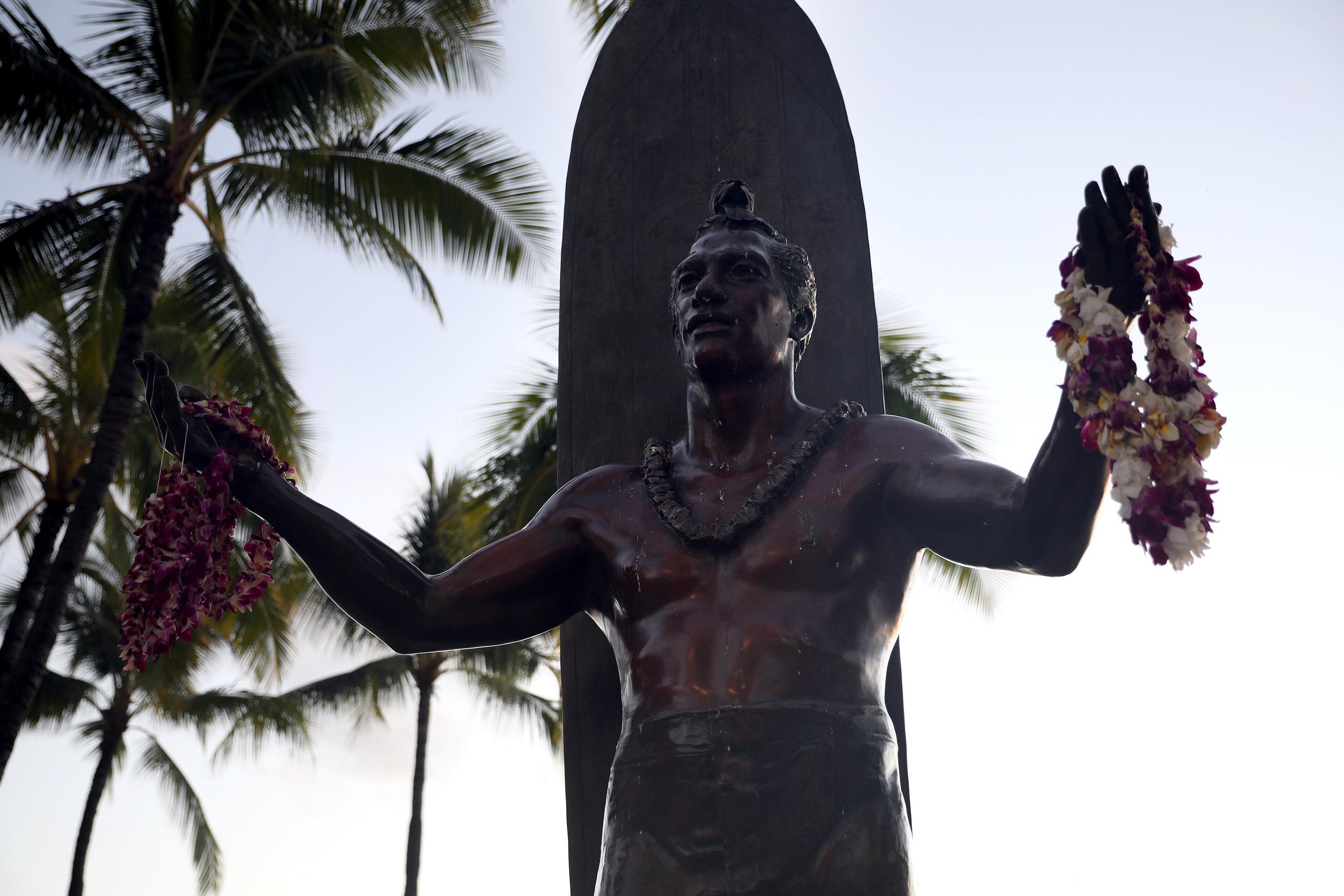
A nine-foot bronze Duke Kahanamoku stands on Kūhiō Beach with his arms out and a surfboard at his back. He won five Olympic medals, served as Honolulu’s sheriff and spent his later years greeting visitors for Hawaiʻi. Here is the man, the statue, the hula show beside it and the swim basins behind it, with what is free and when.
Some links on this page are affiliate links. If you book or buy through them, we may earn a commission at no extra cost to you.
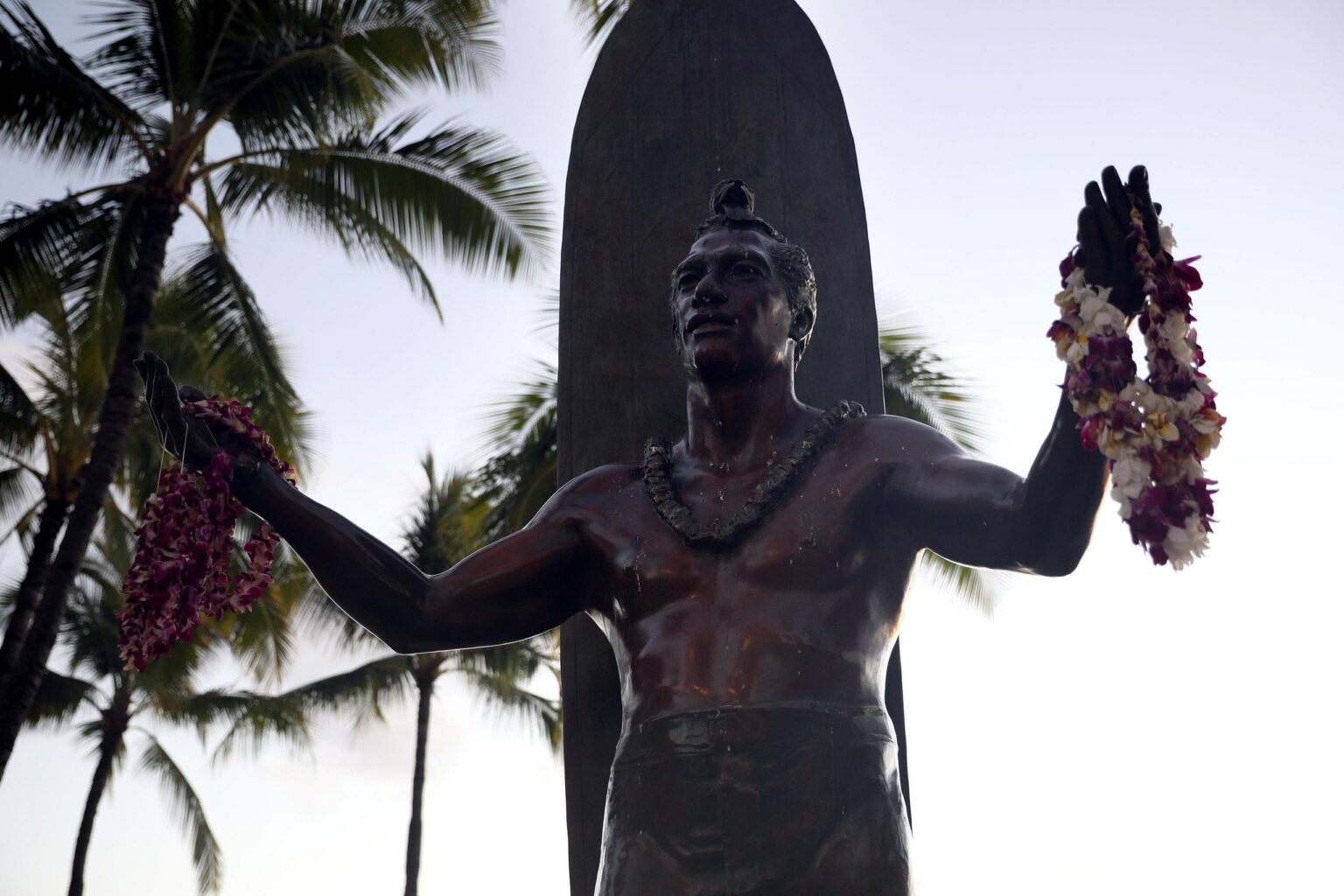
The Duke Kahanamoku statue at Kūhiō Beach, a lei in each hand. Photo: Gage Skidmore, CC BY-SA 2.0, via Wikimedia Commons.
Quick Answer
The statue is free to see on Kūhiō Beach in Waikīkī, in a park the City closes from midnight to 5 a.m. The 9-foot bronze is by Jan Gordon Fisher and went up in 1990, the 100th anniversary of Duke’s birth. The free Kūhiō Beach Hula Show is on the grass beside it on Saturdays, 6:30 to 7:30 p.m. Lifeguard towers on this beach are staffed 8 a.m. to 6:30 p.m. Duke’s birthday, August 24, is marked here with fresh lei.
- The statue
- Cast bronze, 9 feet, by Jan Gordon Fisher; installed in 1990
- Park hours
- Closed 12 a.m. to 5 a.m. (City Parks and Recreation)
- Admission
- Free
- Lifeguards
- Towers 2C, 2DP and 2D at Kūhiō Beach Park, 8 a.m. to 6:30 p.m.
- Hula show
- Kūhiō Beach Hula Mound, Saturdays 6:30 to 7:30 p.m., free
- Parking
- Honolulu Zoo lot, $1.50 an hour, 4-hour limit; the Waikīkī Shell lot is free (per the zoo)
- Birthday
- August 24, marked with fresh lei at the statue
Facts from the City’s public art record, Parks and Recreation notices and zoo page, Honolulu Ocean Safety, the Kūhiō Beach Hula Show’s own page and the Duke Kahanamoku Foundation, checked Oct 25, 2026.
Who Duke Kahanamoku Was
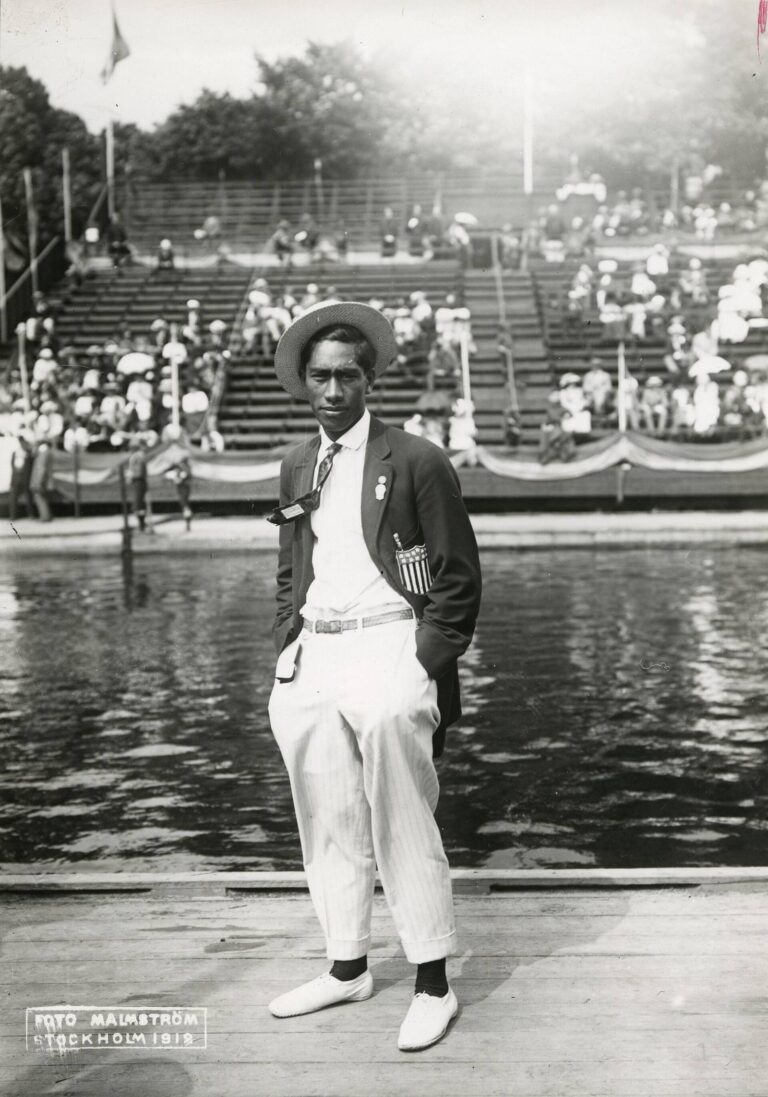
In July 1912, with the Olympic Games still running in Stockholm, the Hawaiian Gazette in Honolulu ran an editorial headed “Duke Kahanamoku.” It backed a fund, started by another Honolulu paper, to give him a tangible thank-you from his hometown. It also made a prediction: his feats “on the mainland of America first and now at Stockholm will do more to make Waikiki known throughout the world than tons of printed matter sent out from Hawaii.” The paper called him “the canoe boy of Waikiki” (Hawaiian Gazette, July 12, 1912, page 4).
He was 21.
Duke Paoa Kahanamoku was born in Honolulu on August 24, 1890, and grew up in Waikīkī’s Kālia area (U.S. Olympic & Paralympic Museum; Duke Kahanamoku Foundation). He first made sports headlines in 1911 at the first AAU meet held in Hawaiʻi, where he swam the 100-yard freestyle in Honolulu Harbor in 55.4 seconds. AAU officials on the mainland were in disbelief and questioned whether the time was legitimate. It was. A year later he won gold in the 100-meter freestyle at Stockholm (Hall of Fame).
| Year | Games | Event | Medal |
|---|---|---|---|
| 1912 | Stockholm | 100 m freestyle | Gold |
| 1912 | Stockholm | 4×200 m freestyle relay | Silver |
| 1920 | Antwerp | 100 m freestyle | Gold |
| 1920 | Antwerp | 4×200 m freestyle relay | Gold |
| 1924 | Paris | 100 m freestyle | Silver |
That is five medals, three of them gold, over three Games. Some older sources count a sixth, a 1932 water polo bronze. The Hall of Fame lists him that year only as an alternate on the U.S. team, at age 42, so this page counts five.
The medals bought him a second career. The Hall of Fame calls him a “surfing ambassador to the world” who took the sport to California, Australia and New Zealand on homemade wooden boards. His favorite was 16 feet long and weighed 114 pounds. In 1925, after a boat capsized off Southern California, he made three trips through the surf on his surfboard and brought eight people ashore (Hall of Fame). The Honolulu Star-Bulletin called it a “superhuman rescue act” (Duke Kahanamoku OceanFest).
At home he was elected sheriff of Honolulu in 1932 and held the job for nearly 30 years. Then he became the city’s official greeter, welcoming visitors and teaching them island customs (Foundation timeline; Hall of Fame). He died on January 22, 1968, at 77.
The Duke Kahanamoku brand’s own site prints a creed over his signature. It opens: “In Hawai’i we greet friends, loved ones and strangers with Aloha, which means with LOVE” (dukekahanamoku.com).
The Statue: Who Made It and When
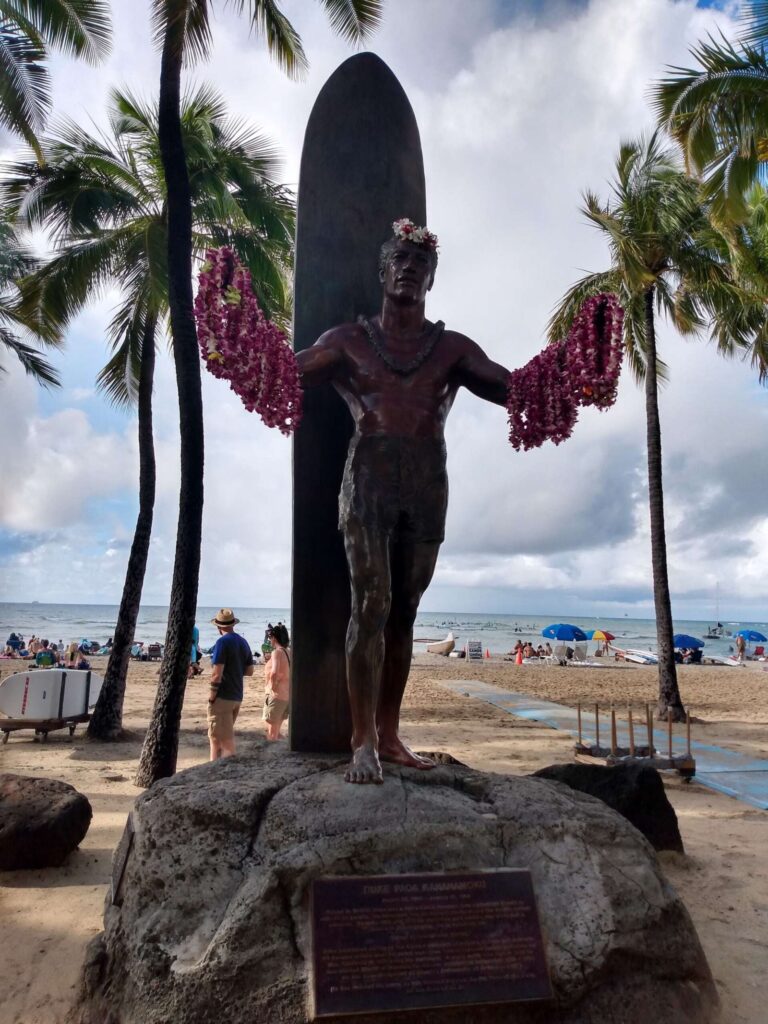
The bronze is 9 feet tall. The Waikiki Improvement Association commissioned Jan Gordon Fisher to make it. It was installed in 1990 to mark the 100th anniversary of Duke’s birth, and the Association gave it to the City in 1995 (Honolulu Star-Advertiser, 2011). The City’s public art record lists it as a gift of the Association and calls it “a larger than life bronze sculpture of Duke Paoa Kahanamoku with his surfboard” (City public art record).
In the photos here he stands on a rough stone base with his arms spread, a lei in each hand and a surfboard upright behind him. The Hawaiʻi Tourism Authority asks visitors not to toss lei onto the outstretched arms, because the acidity of the flowers harms the bronze (HTA).
The lei are the point. The Outrigger Duke Kahanamoku Foundation has held a morning ceremony at the statue on his birthday, August 24, that dresses it in fresh flower lei. Its 2022 listing ran 7 to 8 a.m. (Foundation event page). The Duke Kahanamoku OceanFest, a nonprofit festival of ocean sports, ran August 14 to 24 in 2026 and lists the 24th as Duke Kahanamoku’s Birthday (OceanFest calendar). Only the 2022 ceremony time is online, so check the Foundation’s events page before an August trip.
Around the Statue: Prince Kūhiō and the Stones
Duke, the stones, the Hula Mound and Prince Kūhiō, placed from the City’s public art records and OpenStreetMap, with the zoo lot from the parking section below. Map data © OpenStreetMap contributors.
Kūhiō Beach Park covers 3.4 acres. It passed to City control in March 1936 and carries the name of Prince Jonah Kūhiō Kalanianaʻole. The City’s notice credits the prince, with his brothers, with introducing surfing to the United States (City Parks and Recreation). The City’s art record places a bronze of him by Sean Browne on this beach, about 280 meters (0.17 mile) toward Diamond Head from Duke, by our calculation from the City’s coordinates.
About 50 meters from Duke, by the same coordinates, stand four boulders inside a fence. The City dates them to before Western contact. The Waikiki Historic Trail marker tells their story: four healers from Tahiti, Kapaemahu, Kapuni, Kinohi and Kahāloa, who gave their names and mana to the stones before returning to their homeland. The stones were raised onto a paepae, a stone platform, in 1997 (trail marker).
Another marker, at ʻĀpuakēhau, describes the Waikīkī beachboys as “instructors, companions, musicians, and goodwill ambassadors” whose clients “included Hollywood celebrities and royalty.” It says Duke Kahanamoku and other Native Hawaiians and part-Hawaiians formed the surf club Hui Nalu, “club of the waves,” and that many of its members became the first beachboys. Today, the marker says, beachboys are licensed by the State and must be qualified in life-saving skills (trail marker).
The trail has 23 sites. Its About page says some markers are missing or have been moved and that the Native Hawaiian Hospitality Association’s walking tours run through the year (Waikiki Historic Trail). Every stop is pinned on our Waikiki map.

Waikiki Trolley: Historic Honolulu Red Line
★★★★★ 4.9 · 2,968 reviews · From $35
Check AvailabilityWe may earn a commission if you book through this link, at no extra cost to you.
Swimming at Kūhiō Beach: The Basins and the Wall
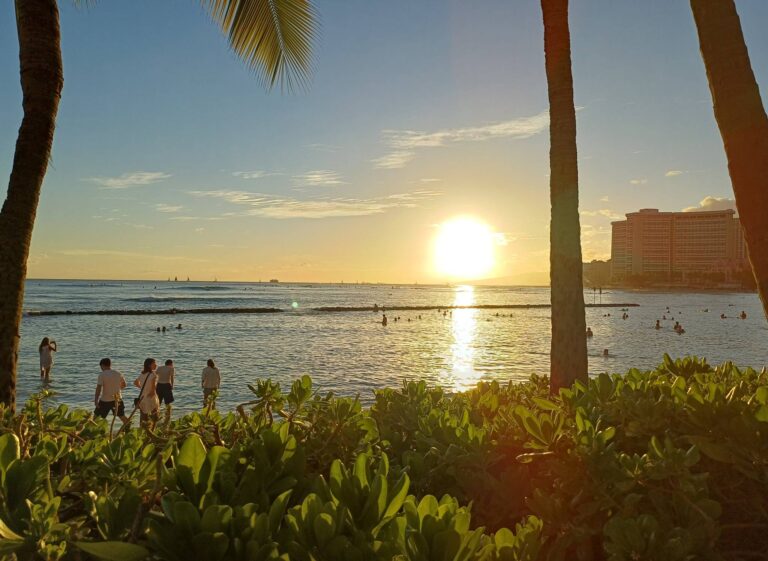
Two concrete walls run out from the sand and divide the beach, which the Hawaiʻi Tourism Authority nicknames “Kūhiō Ponds.” The result, in its words, is “a calm swimming enclosure that is ideal for children and families” (HTA). The State calls the enclosures swim basins (DLNR).
Honolulu Ocean Safety lists towers 2C, 2DP and 2D at Kūhiō Beach Park, plus tower 2B at the Waikīkī Police Station. Towers are open 8 a.m. to 6:30 p.m. daily (Ocean Safety).
HTA lists bodyboarding, bodysurfing and surfing among the activities here, and says Queen’s Surf Beach, next toward Diamond Head, is popular with bodyboarders (HTA). Its warning about the wall is plain: “The Waikīkī Wall is only meant for walking. Please don’t jump off it as it is dangerous for adults and children alike.”
The State says it is aiming to start construction in fall 2026 on the two basins: sand moved back to shore from the outer edges, a rock groin to replace the temporary sandbag groin, and the boundary-wall rocks restacked (DLNR). Its page lists no closure or fencing, and shows no update date, so look at the basin the week you go. Our Waikiki beaches guide covers the rest of the shoreline, and surf lessons in Waikiki compares the schools.
A beach access mat for wheelchairs runs from the sidewalk toward the ocean just ʻEwa of the statue. The City installed it in 2018, five feet wide and more than 75 feet long (City), and its beach-wheelchair page still lists a mat by the statue (DPR).

Outrigger Canoe Surfing at Waikiki, 20 Minutes
★★★★★ 4.6 · 127 reviews · From $52
Check AvailabilityWe may earn a commission if you book through this link, at no extra cost to you.
The Hula Mound: Saturday Night on the Grass
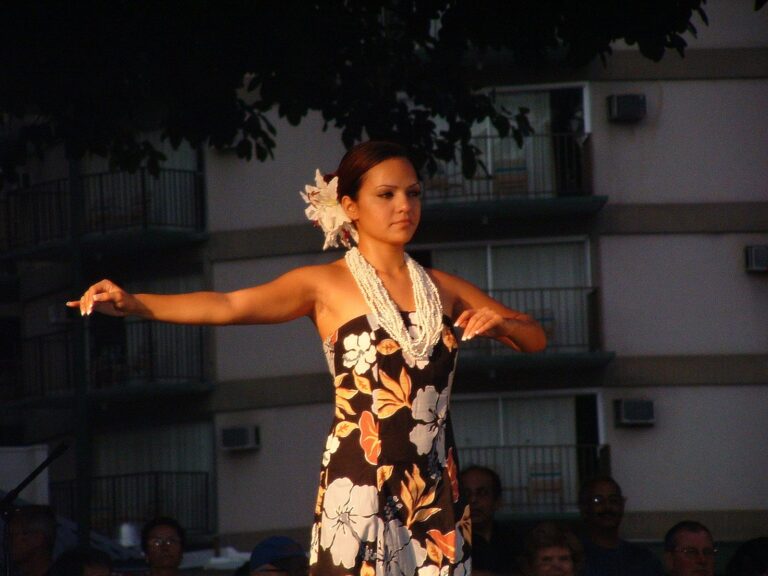
The Kūhiō Beach Hula Show runs Saturdays, weather permitting, 6:30 to 7:30 p.m., on the Kūhiō Beach Hula Mound. The mound is on the ocean side of Kalākaua Avenue near the Duke statue, diagonally across from the Hyatt Regency Waikiki. A conch shell opens the show. It is free and outdoors, seating is on the grass, and beach chairs and mats are fine (show page).
The Waikiki Improvement Association, a nonprofit, has presented it for more than 30 years. As of Nov 8, 2026, the schedule page lists no skipped Saturdays for the rest of the year; it skipped July 4, September 19, October 17 and October 31 “due to special events.” Tuesday shows ended after June 2026 (schedule). For a call, the show gives 808-843-8002. More free evenings are in free things to do in Waikiki, and our Waikiki sunset guide covers where to stand before the show.
This stretch had another name in the 1800s. The Waikiki Historic Trail’s Uluniu marker says King Kalākaua kept a two-story wooden house here in a grove of old coconut trees and gave parties. A guest quoted on the marker wrote that after the feast and the dancing, they “witnessed the native dance called ‘The Hoolah’” (trail marker).
Getting There and Parking
From the restaurant that carries his name, Duke’s Waikiki under the Outrigger, the statue is a 5-minute walk east, by our review’s count. LeaLea Trolley’s Manoa/UH line lists a Duke Kahanamoku Statue stop; our trolley comparison has the schedule. Fares and routes for TheBus are in Getting Around Oahu.
The nearest lot we can confirm is Honolulu Zoo’s, entered from Kapahulu Avenue: $1.50 an hour, four hours at a time, with machines that take cards, bills and exact-change coins (City). The zoo says the lot at the Waikīkī Shell across Monsarrat Avenue has free parking (Honolulu Zoo). By our count in the Kapiʻolani Park guide, it is about 7 minutes on foot from the statue to the zoo corner and 15 to the Shell. Garages and rates are in our Waikiki parking guide, and the things to do in Waikiki guide has the rest of the neighborhood.
The park is closed from midnight to 5 a.m. The City lengthened that closure in June 2023, from 2 a.m. to 5 a.m. (City notice; closure list). For something after the statue, the Waikīkī Aquarium and the park lawns lie about 15 minutes toward Diamond Head on foot, by our count.
Duke Kahanamoku Statue Questions
Who made the Duke Kahanamoku statue?
Jan Gordon Fisher. The Waikiki Improvement Association commissioned the 9-foot bronze, installed it in 1990 for the 100th anniversary of Duke’s birth and gave it to the City in 1995.
Where is the Duke Kahanamoku statue?
On Kūhiō Beach in Waikīkī, on the ocean side of Kalākaua Avenue, near the Kūhiō Beach Hula Mound and diagonally across from the Hyatt Regency Waikiki.
How many Olympic medals did Duke Kahanamoku win?
Five, per the U.S. Olympic & Paralympic Hall of Fame: three gold (100-meter freestyle in 1912 and 1920, 4×200-meter relay in 1920) and two silver (relay in 1912, 100-meter freestyle in 1924).
Why are there lei on the Duke Kahanamoku statue?
Lei honor him. A Foundation ceremony on his birthday, August 24, has dressed the statue in fresh flower lei. The Hawaiʻi Tourism Authority asks visitors not to toss lei onto the arms, because the flowers’ acidity harms the bronze.
When is the Kūhiō Beach hula show?
Saturdays, weather permitting, 6:30 to 7:30 p.m., at the Kūhiō Beach Hula Mound. It is free. As of Nov 8, 2026, its schedule lists no skipped Saturdays for the rest of the year.
Is Kūhiō Beach good for swimming?
Yes, inside the two walls. The Hawaiʻi Tourism Authority calls the enclosure calm and ideal for children and families, and Ocean Safety staffs towers 2C, 2DP and 2D from 8 a.m. to 6:30 p.m. The State aims to start work on the swim basins in fall 2026.
Can you park at the Duke Kahanamoku statue?
The nearest lot we can confirm is Honolulu Zoo’s on Kapahulu Avenue, $1.50 an hour with a four-hour limit, about a 7-minute walk away. The zoo says the Waikīkī Shell lot is free.
Sources, checked Oct 25, 2026
- Duke Kahanamoku (U.S. Olympic & Paralympic Museum Hall of Fame)
- Duke’s Life timeline (Outrigger Duke Kahanamoku Foundation)
- Sunrise birthday lei draping, Aug 24, 2022 (Duke Kahanamoku Foundation)
- Events calendar (Duke Kahanamoku Foundation)
- Duke Kahanamoku OceanFest 2026 calendar
- Ambassador of Aloha, Duke’s Creed (dukekahanamoku.com)
- The Hawaiian Gazette, July 12, 1912, page 4 (Library of Congress)
- Duke Kahanamoku statue to be conserved (Honolulu Star-Advertiser, Feb 15, 2011)
- Public art record (City and County of Honolulu open data)
- Duke Kahanamoku Statue (Hawaiʻi Tourism Authority)
- Kūhiō Beach (Hawaiʻi Tourism Authority)
- Queen’s Surf Beach (Hawaiʻi Tourism Authority)
- Kūhiō Beach Park closure hours (City Parks and Recreation, Jun 1, 2023)
- Park closure hours (City Parks and Recreation)
- New beach access mat at Kūhiō Beach Park (City, Apr 4, 2018)
- Beach wheelchairs and access mats (City Parks and Recreation)
- Lifeguard tower locations (Honolulu Ocean Safety)
- Waikīkī beach restoration (State DLNR, OCCL)
- Kūhiō Beach Hula Show (Waikiki Improvement Association)
- Kūhiō Beach Hula Show schedule
- The Healing Stones of Kapaemahu (Waikiki Historic Trail)
- Uluniu (Waikiki Historic Trail)
- ʻĀpuakēhau Stream and Waikīkī Beach Boys (Waikiki Historic Trail)
- About the Waikiki Historic Trail
- Honolulu Zoo (City)
- Plan your visit (Honolulu Zoo)
Researched from the sources above, checked Oct 25, 2026. We never claim a visit we did not make; first-hand notes are marked as Stew’s. How we research and review.
Leave a Reply