
History & Culture · The Monarchy
Queen Liliʻuokalani and the 1893 Overthrow
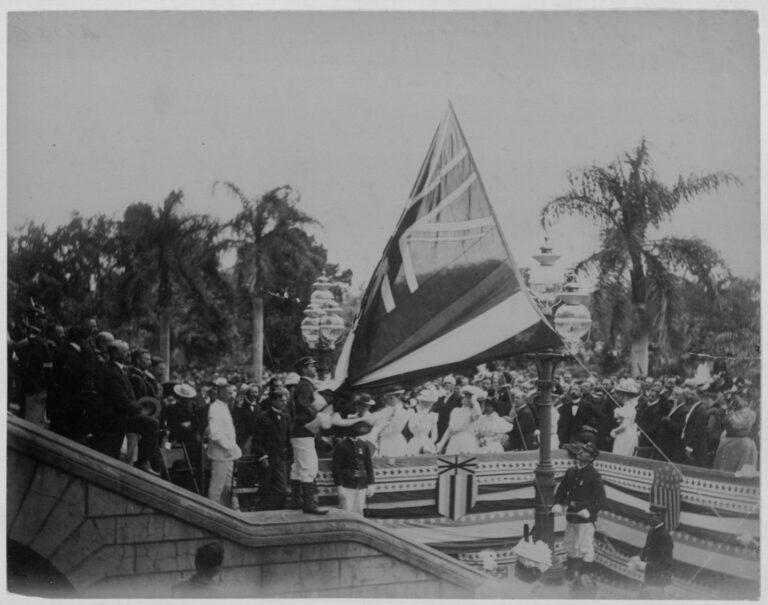
Queen Liliʻuokalani was the last reigning monarch of Hawaiʻi. On January 17, 1893, a Committee of Safety proclaimed a new government while U.S. Marines stood on shore, and she lost her throne. Two years later she was a prisoner in an upstairs bedroom of her own palace, where she stitched a quilt that is still there.
Some links on this page are affiliate links. If you book or buy through them, we may earn a commission at no extra cost to you.
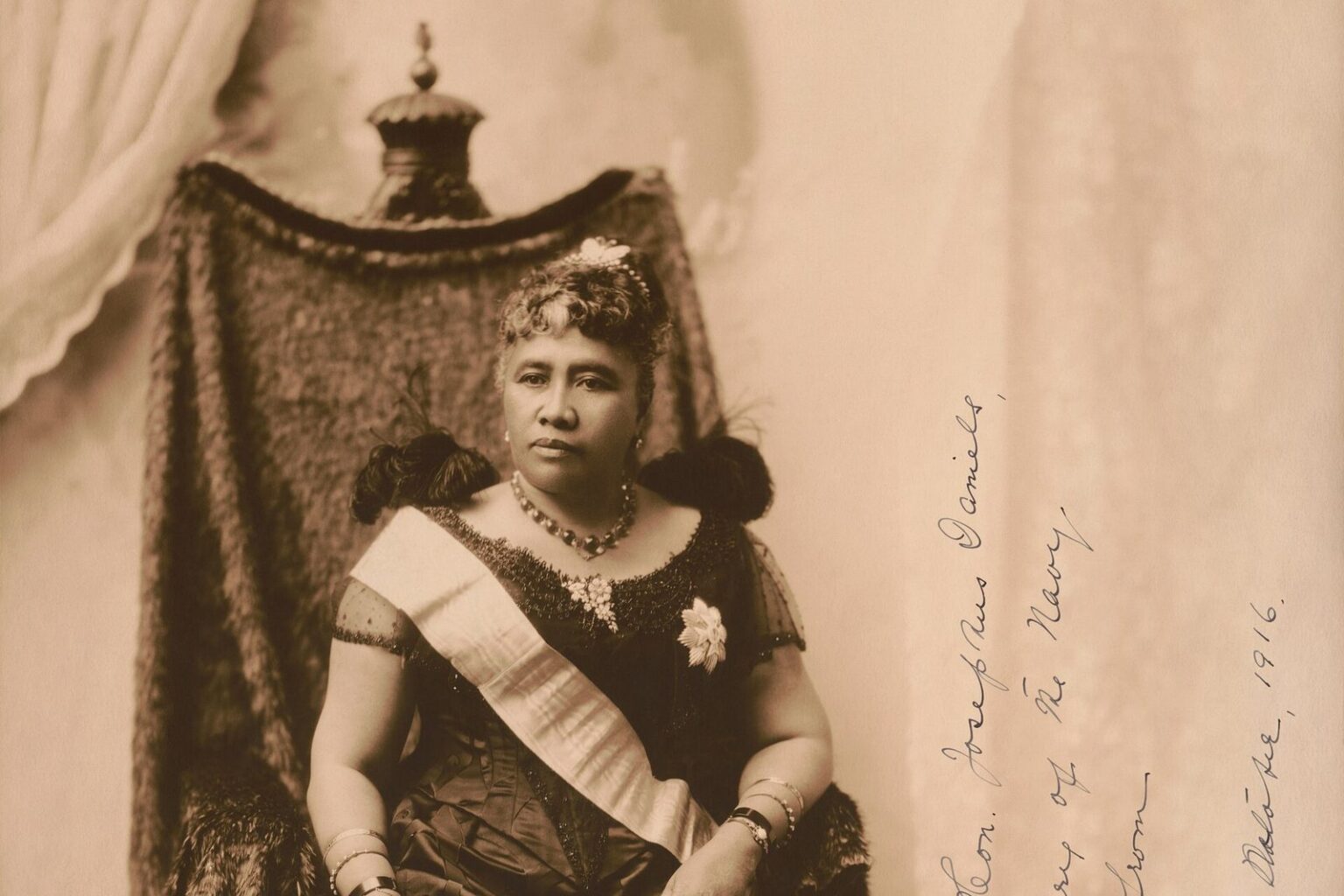
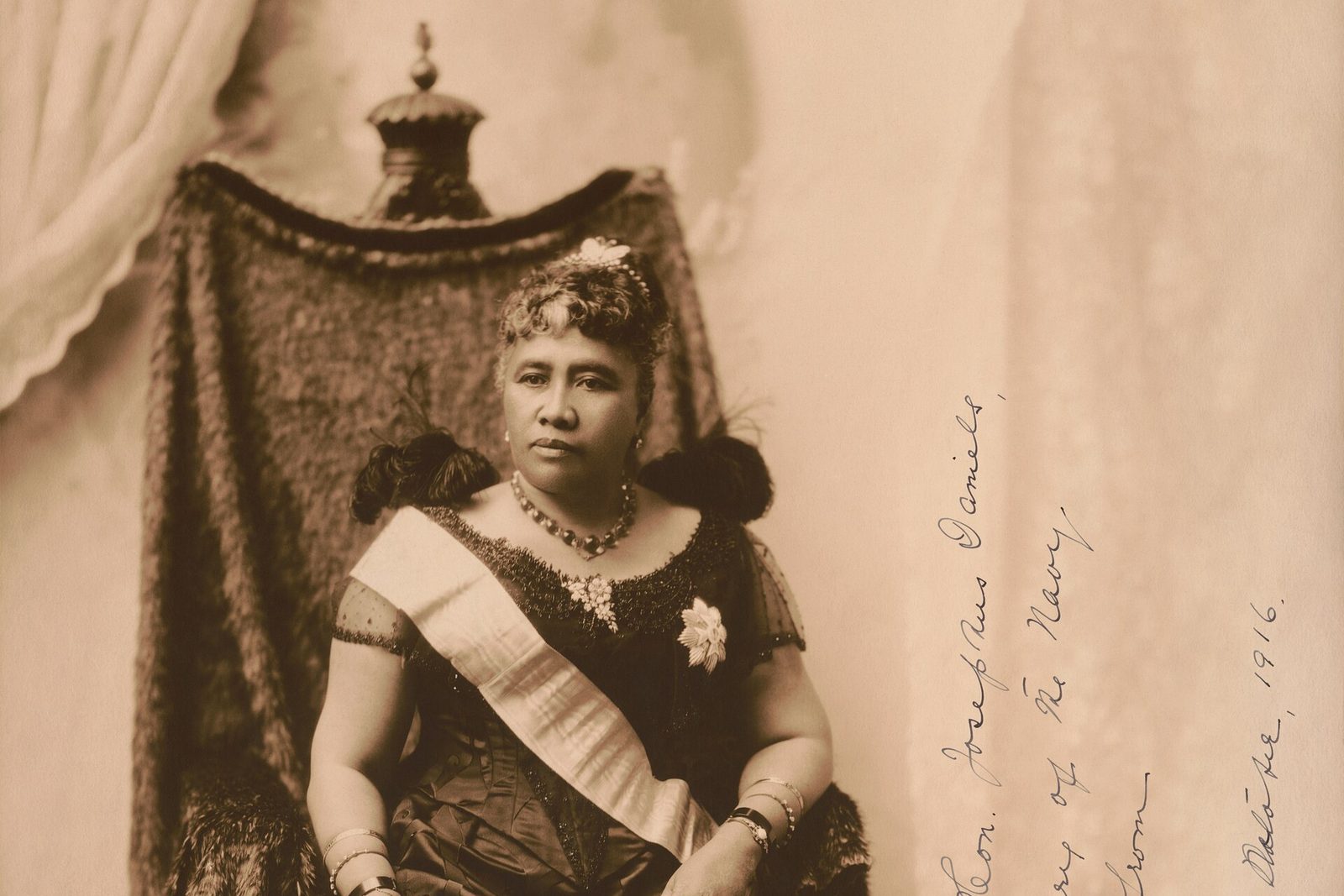
Queen Liliʻuokalani in a portrait made about 1891 (Library of Congress). Photo: James J. Williams, Public domain, via Wikimedia Commons.
Quick Answer
Hawaiʻi’s last reigning monarch, overthrown on January 17, 1893. Liliʻuokalani became queen when her brother Kalākaua died on January 20, 1891. A Committee of Safety proclaimed a Provisional Government on January 17, 1893, the day after marines from the USS Boston landed, and that evening she signed a protest yielding to “the superior force of the United States.” President Cleveland called the overthrow an act of war. The Republic of Hawaiʻi arrested her in 1895 and held her in ʻIolani Palace for nearly eight months. She died on November 11, 1917. Congress apologized in 1993.
1895: A Quilt in the Room Where She Was Held
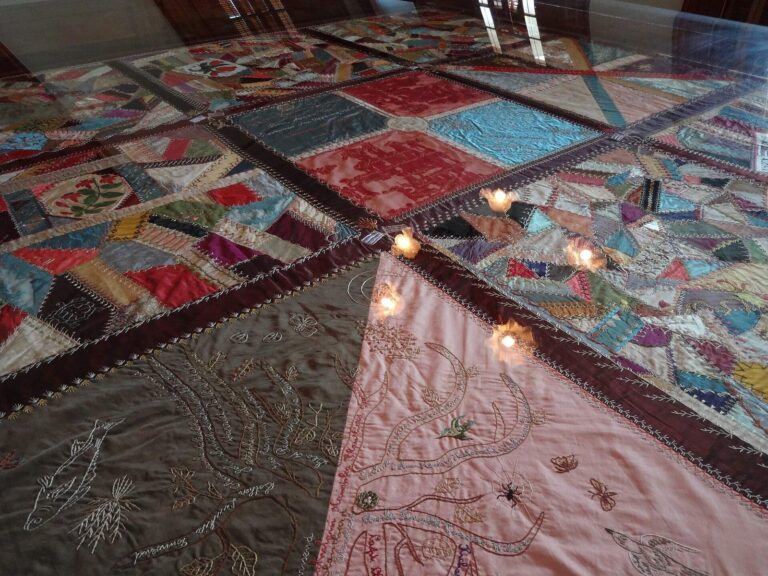
In a second-floor bedroom of ʻIolani Palace, under a plexiglass dome, lies a quilt 97 inches by 95. Nine panels of velvets, satins and silks, worked by hand. The Palace says the Queen and her companions made it.
She was held in that room for nearly eight months. The Palace says she was denied visitors except for one lady companion, and that her days there ran to prayers, music, crochet-work and quilting.
She had no newspapers. She did have paper. “Writing-paper and lead-pencils were not denied,” she wrote later, “and I was thereby able to write music, after drawing for myself the lines of the staff.”
The court that sent her there had met in her own throne room. A military tribunal convicted and fined her. The sentence was five years at hard labor, which the Palace says was reduced to the bedroom.
January 14 to 17, 1893: How She Lost the Throne
At noon on Saturday, January 14, 1893, Liliʻuokalani prorogued the legislature and went to the Blue Room to wait for her cabinet. In the throne room the diplomatic corps and the justices of the supreme court were waiting, along with legislators and a committee of the Hui Kālaiʻāina. She had asked them there to see her promulgate a new constitution.
The one in force dated from 1887. It had been “forced upon my brother,” she wrote, and it “made the sovereign inferior to the cabinet.” Petitions for a new one had come in from every part of the islands, and those in a position to know, she wrote, estimated that “six thousand five hundred, or two-thirds,” of the registered voters had signed them.
The ministers arrived more than half an hour late. They did not think it advisable, they told her; there was danger of an uprising. “They had led me out to the edge of a precipice,” she told the American commissioner afterward, “and now were leaving me to take the step alone. It was humiliating.”
She yielded. She told her guests that, on her ministers’ advice, she would wait, as they had promised her a new constitution on some future day.
Two days later American troops came ashore.
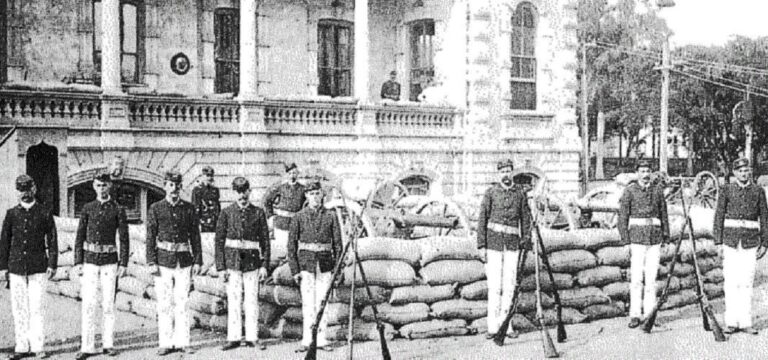
They came from the USS Boston, late in the afternoon of Monday, January 16. Cleveland would tell Congress that marines came ashore between four and five o’clock, “upward of 160 in all,” with two pieces of artillery. By her account the order came from the American minister, J. L. Stevens. She was told they were there for the safety of American citizens. “Why had they landed when everything was at peace?” she asked, and why had they not “gone to the residences, instead of drawing in line in front of the palace gates, with guns pointed at us, and when I was living with my people in the palace?”
On Tuesday afternoon, at about half past two, the Provisional Government was proclaimed. Nearly fifteen minutes later a man named J. S. Walker came to the palace on what he called a “painful duty.” The opposition party, he said, had requested that she abdicate.
She sent for her ministers. With American troops landed to support the revolutionists, they concluded, it would be impossible to resist. At six that evening she signed a protest. It said she yielded “to the superior force of the United States of America,” whose minister “has caused United States troops to be landed at Honolulu,” and only until the American government, shown the facts, undid its minister’s action and reinstated her.
At ten the next morning she moved to Washington Place “of my own accord, preferring to live in retirement.”
What Washington Found: Blount, Stevens and Cleveland
President Grover Cleveland withdrew the annexation treaty from the Senate on March 9, 1893. Two days later he appointed a special commissioner, James Blount, to find out what had happened in Honolulu. Blount dated his report July 17.
One page of it makes the case in a run of “but for” sentences. “The leaders of the revolutionary movement would not have undertaken it but for Mr. Stevens’s promise to protect them against any danger from the Government. But for this their mass meeting would not have been held. But for this no request to land the troops would have been made. Had the troops not been landed no measures for the organization of a new Government would have been taken.”
Stevens had put his own view in writing on February 1. “The Hawaiian pear is now fully ripe,” he wrote to the State Department, “and this is the golden hour for the United States to pluck it.” Cleveland would quote the line in his message to Congress.
Cleveland’s envoy, Albert Willis, reached Honolulu on Saturday, November 4. His instructions were to tell the Queen of the President’s regret, and that once she was reinstated he “expects that she will pursue a magnanimous course by granting full amnesty to all who participated in the movement against her.”
She first told Willis that amnesty was “beyond my powers as a constitutional sovereign.” On Monday, December 18, at Washington Place, she gave him a document agreeing that the people who set up or supported the Provisional Government “should have full amnesty in their persons and their property.”
That same day, December 18, 1893, Cleveland sent Congress his conclusion. “By an act of war, committed with the participation of a diplomatic representative of the United States and without authority of Congress,” he wrote, “the Government of a feeble but friendly and confiding people has been overthrown. A substantial wrong has thus been done which a due regard for our national character as well as the rights of the injured people requires we should endeavor to repair.”
The Provisional Government refused to step aside. Congress later recorded that it “protested President Cleveland’s call for the restoration of the monarchy and continued to hold state power.” The Senate Committee on Foreign Relations held its own hearings from December 27, 1893, to February 26, 1894, in which members of the Provisional Government justified Stevens’s actions and recommended annexation.
On July 4, 1894, the Provisional Government declared itself the Republic of Hawaiʻi.
January 1895: The Warrant, the Abdication and a Borrowed Name
On January 16, 1895, Deputy Marshal Arthur Brown and Captain Robert Waipa Parker came up the walk from Beretania Street to Washington Place. Brown had a warrant. He “would not permit me to take the paper which he held, nor to examine its contents,” she wrote.
A royalist attempt to restore her had failed, and the Palace says that attempt led to her arrest. The carriage took her through the palace gates, past soldiers camped across the grounds. “Staring directly at us were the muzzles of two brass field pieces.”
On the morning of January 24 the official copy of an abdication was handed to her. It had been drawn out for the men in power by their own lawyer, A. S. Hartwell. “The idea of abdicating never originated with me,” she wrote. She signed, she said, because she was told that by signing, all the people who had been arrested would be released. She also wrote that she had been told six others besides herself had been selected to be shot for treason, and that she still believed “murder was the alternative.”
Then came the signature line. She was told to sign “Liliuokalani Dominis,” her late husband’s surname. She asked twice what the form of signature was to be and got the same answer. She wrote what they dictated. “There is not, and never was, within the range of my knowledge, any such a person as Liliuokalani Dominis.”
On February 27 the sentence was read: “a fine of $5,000, and imprisonment at hard labor for five years.” It was never carried out, she wrote, and its purpose was “to terrorize the native people and to humiliate me.”
On September 6, 1895, Colonel McLean told her he was no longer responsible for her custody and that at three o’clock she could leave the palace. A carriage took her to Washington Place. “The flowers, the shrubs, the trees, had never to me looked so charming.” The Washington Place site says she was kept under house arrest there until February 1896.
1897: The Protest She Filed in Washington
In June 1897 she was in Washington, where a treaty of annexation had been signed by three men she named: Hatch, Thurston and Kinney. On June 17 she signed a protest against it. The treaty, she wrote, was “an act of gross injustice to me.” Then she turned to numbers. “Because my people, about forty thousand in number, have in no way been consulted by those, three thousand in number, who claim the right to destroy the independence of Hawaii.”
The figures were hers. The petitions that Hawaiians carried to the Senate that year are a separate, documented record, and our guide to when Hawaiʻi became a state tells that story. The treaty never reached a final vote. Congress said in 1993 that the Provisional Government was “unable to rally the support from two-thirds of the Senate needed to ratify a treaty of annexation.” Annexation came by joint resolution instead, which President McKinley signed on July 7, 1898. The transfer of sovereignty followed on August 12.
She published her own account that year, Hawaii’s Story by Hawaii’s Queen, printed in Boston by Lee and Shepard.
The Songs and the House: Washington Place
The Washington Place site says she composed over 150 songs and chants. She wrote Onipaʻa, “Standing Firm,” at the house in 1864 for a music school, and it “served as a song of strength.” Her most famous, Aloha ʻOe, is in the site’s words “a love song written during her tour around Oʻahu in 1878 when she saw a tender farewell between a young couple.” She began it at Maunawili and finished it at Washington Place.
Washington Place was her home from her marriage in 1862 until her death on November 11, 1917, at the age of 79. The wife of Charles McCarthy, the first governor to live there after her, began the custom of placing lei on the Queen’s armchair. The site says it “continues today.”
1993: Congress Apologizes
In 1993 Congress passed a joint resolution on the overthrow. Its preamble says that “without the active support and intervention by the United States diplomatic and military representatives, the insurrection against the Government of Queen Liliuokalani would have failed for lack of popular support and insufficient arms.”
The resolution “apologizes to Native Hawaiians on behalf of the people of the United States for the overthrow of the Kingdom of Hawaii on January 17, 1893 with the participation of agents and citizens of the United States.” It was approved on November 23, 1993.
Where to Follow Her Story in Honolulu
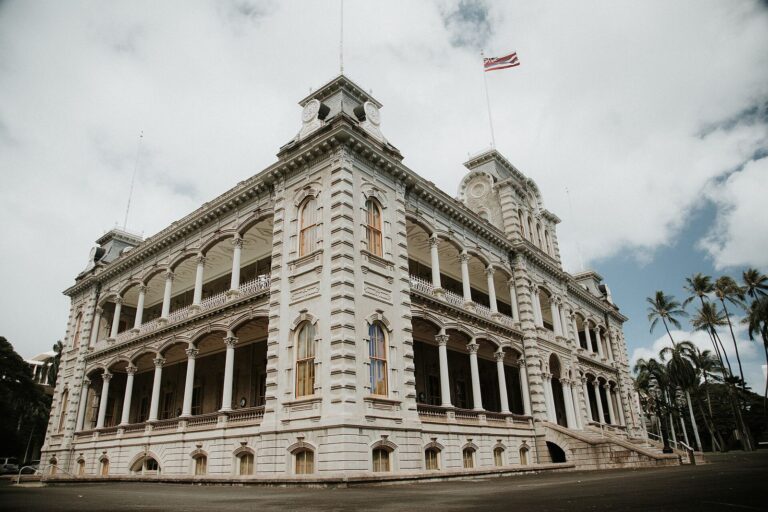
ʻIolani Palace, at 364 South King Street, is where the quilt is. The Palace shows it in the upstairs bedroom where she was held. Our ʻIolani Palace tour guide covers tickets and which tour to book.
The statue “Spirit of Liliʻuokalani,” by Marianna Pineda, stands between the Palace and the State Capitol.
Washington Place, at 320 South Beretania Street, was her private residence for 55 years and is still the governor’s residence. The state calls it “the only official residence of a state governor in the United States that was also home to a monarch.” Its own site says tours of the home are suspended for renovation that is “expected through 2027,” and that “there may be tour opportunities in late 2026.” It still said so on November 1, 2026, so check the site before you plan a stop.
The Waikiki Trolley’s Historic Honolulu Line lists a State Capitol/ʻIolani Palace stop. A downtown morning can pair with a Pearl Harbor afternoon: our comparison of Pearl Harbor tours from Waikiki and our USS Arizona Memorial guide cover that half of the day, and our guide to things to do on Oʻahu has the rest of downtown.

Waikiki Trolley Historic Honolulu Red Line
★★★★★ 4.9 · 2,964 reviews · From $35
Check AvailabilityWe may earn a commission if you book through this link, at no extra cost to you.
Queen Liliʻuokalani Questions
Who was Queen Liliʻuokalani?
Hawaiʻi’s last reigning monarch. She became queen on the death of her brother Kalākaua on January 20, 1891, lost her throne on January 17, 1893, and died at Washington Place on November 11, 1917, at 79.
When was Queen Liliʻuokalani overthrown?
On January 17, 1893, when a Committee of Safety proclaimed a Provisional Government. U.S. Marines from the USS Boston had landed the day before. She signed a protest that evening yielding to the superior force of the United States.
Why was Queen Liliʻuokalani imprisoned?
A royalist attempt to restore her failed in 1895, and she was arrested on January 16, 1895. The Palace says she was tried before a military tribunal in her own throne room and held in an upstairs bedroom for nearly eight months. She was released on September 6, 1895.
Did Queen Liliʻuokalani abdicate?
She signed an abdication on January 24, 1895, while imprisoned. Congress says representatives of the Republic of Hawaiʻi forced her to; she wrote that the idea never originated with her.
What song did Queen Liliʻuokalani write?
Aloha ʻOe is her most famous. The Washington Place site says she wrote it during a tour around Oʻahu in 1878 and finished it at Washington Place. The site counts over 150 songs and chants.
Can I see Queen Liliʻuokalani’s quilt?
Yes. ʻIolani Palace shows it under a protective dome in the second-floor bedroom where she was held. Our ʻIolani Palace tour guide covers tickets.
Sources, checked Nov 1, 2026
- ʻIolani Palace (Friends of ʻIolani Palace), ‘Queen’s Imprisonment’
- ʻIolani Palace (Friends of ʻIolani Palace), ‘Imprisonment Room’
- ʻIolani Palace
- Liliʻuokalani, Hawaii’s Story by Hawaii’s Queen
- Liliʻuokalani, Hawaii’s Story by Hawaii’s Queen
- American Presidency Project
- University of Hawaiʻi at Mānoa Library, The Annexation of Hawaii, Blount Report: Affairs in Hawaii
- University of Hawaiʻi at Mānoa Library, The Annexation of Hawaii, Blount Report: Affairs in Hawaii
- Office of the Historian, Foreign Relations of the United States 1894, Appendix II, Document 245
- University of Hawaiʻi at Mānoa Library, The Annexation of Hawaii, Blount Report: Affairs in Hawaii
- Public Law 103-150 (Apology Resolution), 107 Stat. 1510, govinfo
- Washington Place
- Liliʻuokalani, Hawaii’s Story by Hawaii’s Queen
- Organic Act, 31 Stat. 141, section 1 (govinfo)
- Liliʻuokalani, Hawaii’s Story by Hawaii’s Queen
- Washington Place
- ʻIolani Palace (Friends of ʻIolani Palace), ‘Location, Directions & Parking’
- Office of the Governor, State of Hawaiʻi, ‘Hawaiʻi State Capitol’ visitor brochure
- Washington Place
- Washington Place
- Waikiki Trolley (operator), Historic Honolulu Line
Researched from the sources above, checked Nov 1, 2026. We never claim a visit we did not make; first-hand notes are marked as Stew’s. How we research and review.
Leave a Reply