
History & Culture · Statehood
When Did Hawaiʻi Become a State?
Hawaiʻi became the 50th state on August 21, 1959, when President Eisenhower signed the proclamation in Washington at 4 p.m. Sixty-one years earlier, at noon on the grounds of ʻIolani Palace, the band’s Hawaiian members would not play.
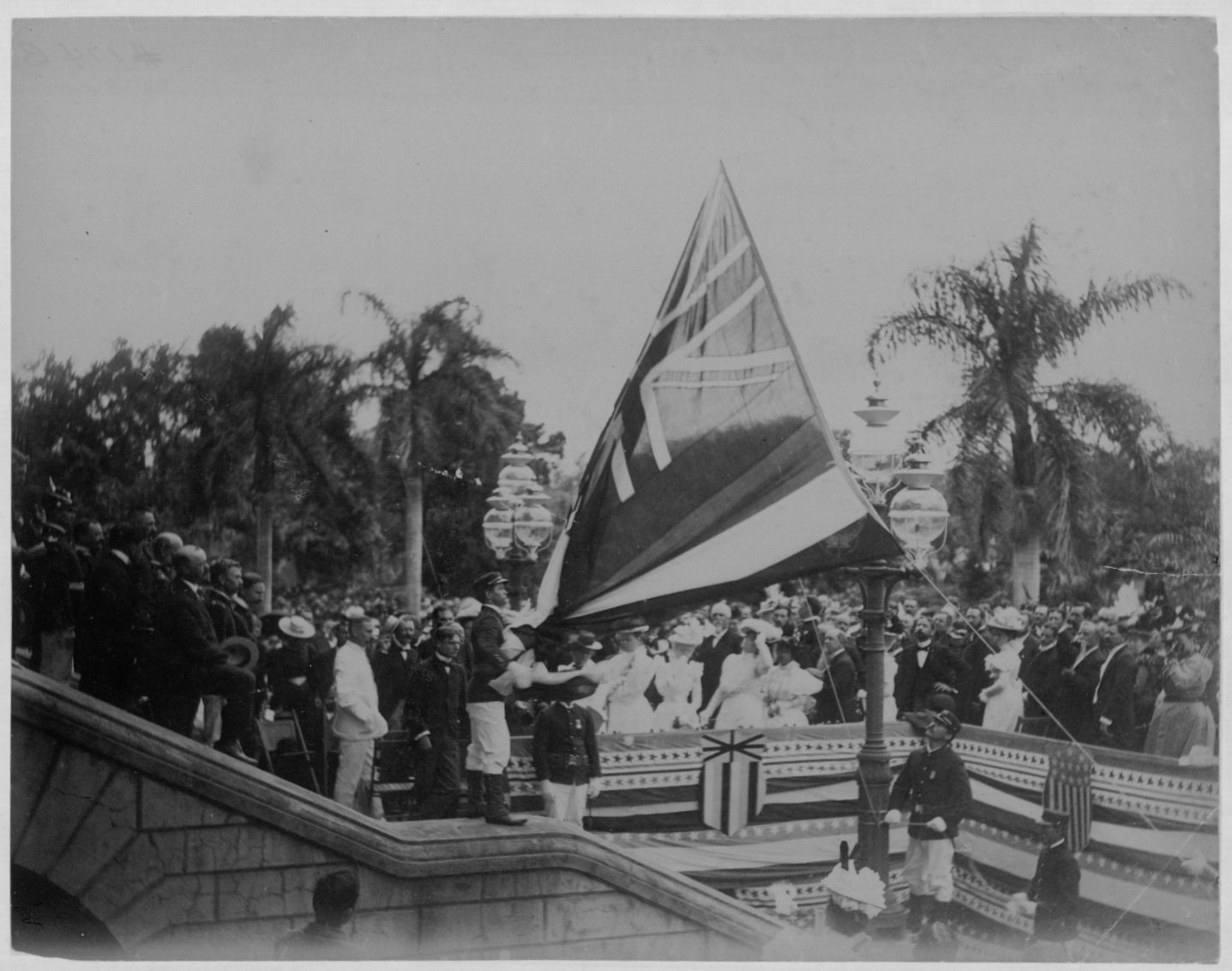
The Hawaiian flag comes down at ʻIolani Palace, August 12, 1898 (Hawaiʻi State Archives). Photo: Frank Davey, Public domain, via Wikimedia Commons.
Quick Answer
August 21, 1959. Congress passed the Hawaiʻi Admission Act in March 1959 and Eisenhower signed it on March 18. Hawaiʻi’s voters approved statehood on June 27, 132,773 to 7,971. Annexation was earlier: President McKinley signed the Newlands Resolution on July 7, 1898, and the Hawaiian flag came down at ʻIolani Palace on August 12, 1898.
August 12, 1898: The Flag Comes Down at ʻIolani Palace
By half past eleven on Friday, August 12, 1898, the American troops from the warships in the harbor had come up from the Queen Street landing and taken their places on the palace grounds. Behind them stood the palace, the Executive Building now. The kingdom it was built for had been gone five years.
President Sanford Dole arrived about twenty minutes later. The American minister, Harold Sewall, read out the resolution Congress had passed in July. Dole answered in a single long sentence and closed it by saying he would “yield up to you as the representative of the Government of the United States, the sovereignty and public property of the Hawaiian Islands.”
The government band played Hawaiʻi Ponoʻī before the Hawaiian flag came down, without its sixteen Hawaiian members. The Pacific Commercial Advertiser reported that they “were so overcome by the events that they retired and would not play the national anthem before the lowering.”
The flag came down at six minutes to twelve.
Charles Kreuter, the band’s cornetist, sounded the call to the colors. The Advertiser wrote: “This was the critical moment. Many were in tears.”
At noon the Stars and Stripes went up. The Independent, which wrote that the flag of a great country had been “unjustly hoisted over Hawaii,” printed its account that day. “The Hawaiians stayed away from the ‘ceremony’ to-day. They know that they are no longer wanted here.”
When Was Hawaiʻi Annexed? A Petition Stopped the First Try
The kingdom had ended on January 17, 1893. That evening Queen Liliʻuokalani signed a protest. She yielded, she wrote, “to the superior force of the United States of America,” and only until the American government undid the action of its minister and restored her.
By September 1897 a treaty of annexation sat in the U.S. Senate, and thousands of people filled Palace Square in Honolulu on the 6th to hear James Kaulia, president of the Hui Aloha ʻĀina. Hawaiʻi, he told them, would never be annexed. In Noenoe Silva’s translation of the Hawaiian newspaper report, he said that if the nation held to its protest, “the Senate can continue to strive until the rock walls of ʻIolani Palace crumble.”
Kaulia asked, “Then where will we live?” The crowd answered, “In the mountains.”
The Hui Aloha ʻĀina petition drive ran from September 11 to October 2 and collected 21,269 signatures of Native Hawaiians on the five main islands, more than half of the roughly 39,000 Native Hawaiians and part-Hawaiians counted in 1897. The signers “earnestly protest against the annexation of the said Hawaiian Islands to the said United States of America in any form or shape.” A second group, the Hui Kālaiʻāina, gathered about 17,000 more on petitions that also asked for the monarchy back, so only the Hui Aloha ʻĀina petition went to Washington.
It ran 556 pages. Four delegates carried it to Washington, James Kaulia, David Kalauokalani, John Richardson and William Auld, arriving on December 6, and Senator George Hoar read it to the Senate three days later. When the delegates left on February 27, 1898, only 46 senators were on record for the treaty. It needed 60. It never came to a final vote.
Congress turned to a joint resolution instead of a treaty. The Newlands Resolution passed the House 209 to 91 and the Senate 42 to 21, and McKinley signed it on July 7, 1898. It declared the islands “annexed as a part of the territory of the United States.”
Five weeks later came the flag.
When Did Hawaiʻi Become a Territory? The Long Wait
On February 26, 1954, Vice President Richard Nixon, sitting as president of the Senate, brought a petition before the chamber on a wooden spool 68 inches wide. Governor Samuel Wilder King had handed it to him. It carried 116,000 signatures, and it asked for what Hawaiʻi had been asking for since 1903.
The territory itself began with the Organic Act, which McKinley signed on April 30, 1900. It made the islands the Territory of Hawaiʻi and took effect on June 14. He named Sanford Dole, the president of the republic that had handed over the islands, as its first governor. Territorial governors were appointed by the president and confirmed by the Senate, not elected. In 1903 the territory’s elected legislature asked Congress to let it hold a constitutional convention and join the Union as a state.
Prince Jonah Kūhiō Kalanianaʻole, Hawaiʻi’s delegate in Congress from 1903 to 1922, said in 1910 that “Hawaii will make the next bid for Statehood, and the request will come soon.” It took nine more years. His bill, H.R. 12210, went in on February 11, 1919, and died in committee.
The next bill came in 1935 from Samuel Wilder King, by then Hawaiʻi’s delegate and the man who would hand Nixon the spool, backed by the sugar planters’ association. A House subcommittee held hearings across the islands that autumn, President Franklin Roosevelt announced his opposition just as they began, and nothing came of it. A joint committee formed in the 75th Congress recommended waiting, citing “the present disturbed condition of international affairs,” and said Congress could not act until “the sentiment of the people” was known.
The people were asked on November 5, 1940. To the question “Do you favor statehood for Hawaii?” they answered yes, 46,174 to 22,428, about two to one.
Hawaiʻi wrote its state constitution nine years before it had a state. The convention opened in Honolulu on April 3, 1950, with King as its president, and voters ratified the constitution on November 7, 1950, 82,788 to 27,109. Then came the spool.
How Hawaiʻi Became the 50th State: Alaska Went First
The plan that worked put Alaska first. In 1958 Hawaiʻi’s delegate, John Burns, worked with Senate Majority Leader Lyndon Johnson and Speaker Sam Rayburn on two steps, Alaska that year and Hawaiʻi the next. Johnson told Burns to hold off, then said publicly that “Hawaii has the best chance for admission at the next session as it has ever had.”
Alaska became the 49th state on January 3, 1959, and the Hawaiʻi bill, S. 50, went in six days later. The Senate voted on it on the evening of March 11. Before the roll call, Johnson said, “This is an important day for our people and our country, and I ask that the Senate now proceed to vote.” The bill passed 76 to 15. The House followed the next day, 323 to 89, and the Honolulu Star-Bulletin put out an extra. A photograph of the newsboy Chester Kahapea holding it ran on the front page of most major newspapers; the State Archives says so in the caption for his 1984 reenactment of the pose.
Eisenhower signed the Admission Act on March 18. Hawaiʻi’s citizens, he said in a statement, would “demonstrate anew to the world the vitality of the principles of freedom and self-determination.” The act would take effect only if they said yes to one question, “Shall Hawaii immediately be admitted into the Union as a State?” On June 27 they did, 132,773 to 7,971, a margin the House history office puts at 17 to 1.
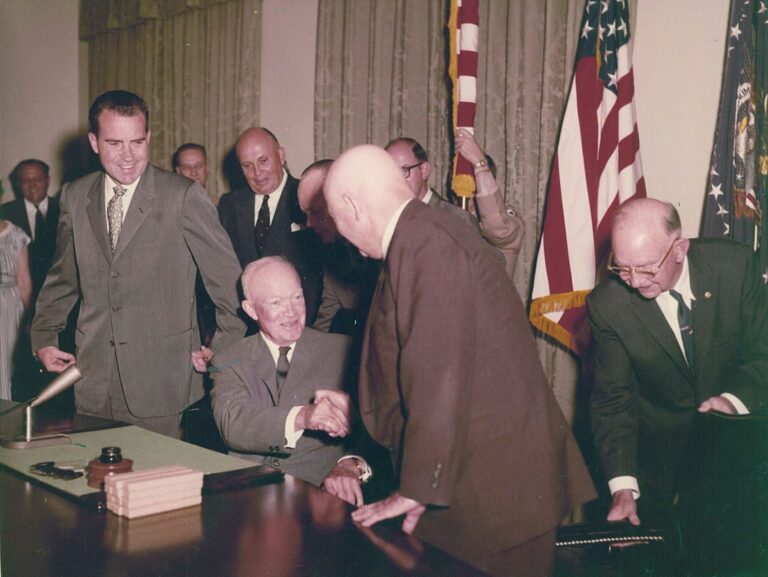
At 4 p.m. on Friday, August 21, Eisenhower signed Proclamation 3309. The Speaker of the House had just reminded him, and he passed it on to the room: “Next Monday will be the first time in 158 years there has not been a Delegate in the membership of the Congress of the United States.” That Monday, August 24, Hawaiʻi’s first senators, Hiram Fong and Oren Long, took the oath and were seated.
The Question the 1959 Ballot Did Not Ask
The ballot offered statehood or staying a territory. Resolutions introduced in Hawaiʻi’s legislature in 2001 and 2002 said the choices “did not include choices for independence from or free association with the United States of America, but only the option of integration with the United States, in the form of a State of the Union, or as a territory of the United States.” Those lawmakers asked the United States and the United Nations to review what was done in 1959.
In 1993 Congress went back to 1893. Public Law 103-150, the Apology Resolution, signed on November 23, 1993, “apologizes to Native Hawaiians on behalf of the people of the United States for the overthrow of the Kingdom of Hawaii on January 17, 1893 with the participation of agents and citizens of the United States.”
The same law states that Native Hawaiians “never directly relinquished their claims to their inherent sovereignty as a people or over their national lands to the United States, either through their monarchy or through a plebiscite or referendum.”
Where to See Hawaiʻi’s Statehood Story in Honolulu
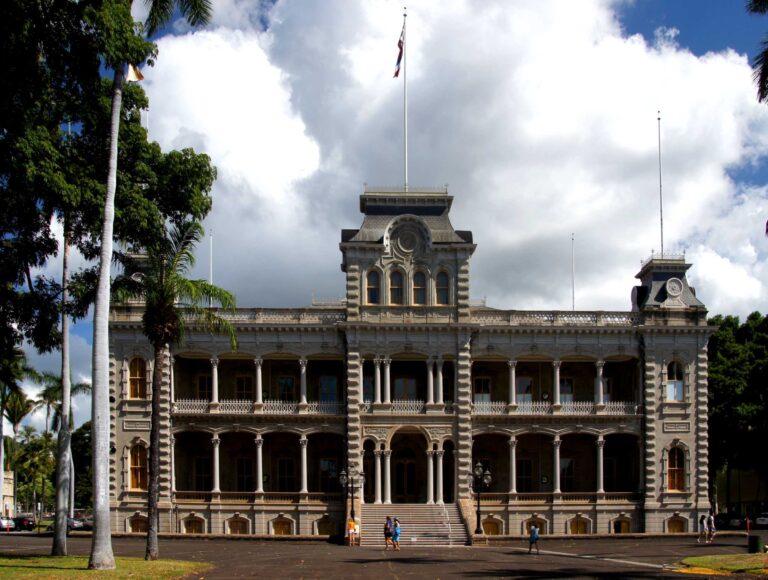
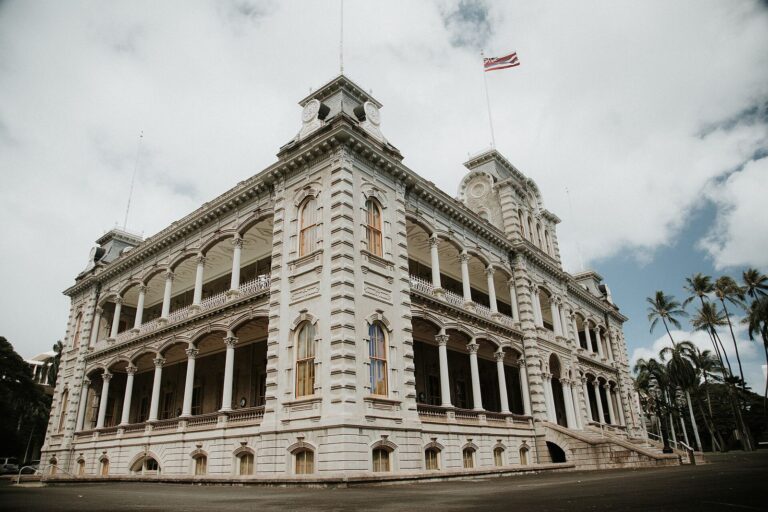
ʻIolani Palace is at 364 South King Street. The transfer took place on its King Street steps, and the National Park Service’s landmark file says the Hawaiian flag “descended ‘like a wound bird.’” Government offices stayed in the palace until 1969. Our ʻIolani Palace tour guide covers tickets and what you see inside.
Next door, the Hawaiʻi State Capitol, at 415 South Beretania Street, was dedicated on March 15, 1969, by Governor John A. Burns, who as delegate had worked the Alaska-first plan. Between the two buildings stands Marianna Pineda’s statue, the Spirit of Liliʻuokalani. Across Beretania Street is Washington Place, the queen’s home for 55 years. She moved back there after the overthrow and lived there until she died in 1917.
Our guide to things to do on Oʻahu has the rest of downtown. Statehood Day, a state holiday, falls on the third Friday in August and marks the proclamation signed August 21, 1959.
On July 4, 1960, the last 49-star flag came down at the palace and the first 50-star flag went up. The State Archives, which sits on the palace grounds and keeps both flags, records who was asked to watch. “Residents and non-residents who attended the flag lowering ceremonies of 1898 were invited to attend as special guests of the State.”
Hawaiʻi Statehood Questions
When did Hawaii become a state?
On August 21, 1959, when President Eisenhower signed Proclamation 3309. Hawaiʻi was the 50th state.
When was Hawaii annexed?
President McKinley signed the Newlands Resolution annexing the islands on July 7, 1898. The transfer of sovereignty took place at ʻIolani Palace on August 12, 1898.
When did Hawaii become a U.S. territory?
The Organic Act, signed April 30, 1900, made the islands the Territory of Hawaiʻi. It took effect on June 14, 1900.
Did Alaska or Hawaii become a state first?
Alaska. It became the 49th state on January 3, 1959, and Hawaiʻi followed as the 50th on August 21, 1959.
How did Hawaii vote on statehood?
On June 27, 1959, voters approved statehood 132,773 to 7,971. The ballot did not offer independence as a choice.
What is Statehood Day in Hawaii?
A state holiday on the third Friday in August, marking the proclamation signed August 21, 1959.
Sources, checked Oct 12, 2026
- Liliʻuokalani, Hawaii’s Story by Hawaii’s Queen
- University of Hawaiʻi at Mānoa Library, Noenoe K. Silva, ‘The 1897 Petitions Protesting Annexation’
- National Archives, ‘The 1897 Petition Against the Annexation of Hawaii’
- National Archives, Pieces of History blog, ‘Protesting Statehood: Hawaiian Women’s Petition Against Annexation’
- Congressional Record, 55th Congress, 2nd session, House, June 15, 1898, pp. 6018-6020
- Congressional Record, 55th Congress, 2nd session, Senate, July 6, 1898, p. 6712
- Statutes at Large, vol. 30, p. 750, Joint Resolution to provide for annexing the Hawaiian Islands to the United States, approved July 7, 1898
- The Independent
- The Pacific Commercial Advertiser
- National Park Service, National Historic Landmark nomination form, ʻIolani Palace
- Statutes at Large, vol. 31, p. 141
- National Archives, Center for Legislative Archives, ‘President William McKinley’s nomination of Sanford B. Dole to be Governor of the Territory of Hawaii, May 4, 1900’
- U.S. House of Representatives, History, Art & Archives, ‘KALANIANAʻOLE, Jonah Kuhio’
- National Archives, Center for Legislative Archives, ‘S. 50, A Bill to provide for the admission of the State of Hawaii into the Union, March 11, 1959’
- U.S. House of Representatives, History, Art & Archives, ‘Asian and Pacific Islander Americans in Congress, 1898-2017’, essay ‘Exclusion and Empire, 1898-1941’
- Congressional Research Service, ‘Admission of States to the Union: A Historical Reference Guide’
- National Archives, Pieces of History blog, ‘Aloha treatment for a 1954 Hawaii petition’
- U.S. House of Representatives, History, Art & Archives, ‘Asian and Pacific Islander Americans in Congress’, essay ‘Exclusion to Inclusion’, section on Alaska and Hawaii statehood
- Statutes at Large, vol. 73, p. 4, Public Law 86-3, ‘An Act To provide for the admission of the State of Hawaii into the Union’
- Dwight D. Eisenhower Presidential Library, White House press release, ‘Statement on the signing of S. 50’, March 18, 1959
- Hawaiʻi State Archives Digital Archives, ‘Statehood – 25th Anniversary City & County of Honolulu program, March 12, 1984’
- Governor William F. Quinn to President Eisenhower, July 2, 1959, certification of the June 27 vote
- Hawaiʻi State Legislature, Senate Resolution 98 (2001)
- Public Law 103-150, 107 Stat. 1510, preamble (govinfo)
- National Archives, Office of the Federal Register, Proclamation 3309, ‘Admission of the State of Hawaii into the Union’
- Dwight D. Eisenhower Presidential Library, White House release, extemporaneous remarks on signing the proclamation, August 21, 1959
- Hawaiʻi State Archives, Inventory of Records of the Hawaii Statehood Celebration Committee
- U.S. Senate, States in the Senate: Hawaii Timeline
- Hawaiʻi Revised Statutes section 8-1, ‘Holidays designated’ (capitol.hawaii.gov)
- ʻIolani Palace
- Office of the Governor, State of Hawaiʻi, ‘Hawaiʻi State Capitol’ visitor brochure; address from https://www.capitol.hawaii.gov/
- Washington Place
- National Archives, Center for Legislative Archives, ‘J. Res. 1 of the Legislature of the Territory of Hawaii, August 15, 1903’; U.S. House History, Art & Archives
- Congressional Record, 86th Congress, 1st session, Senate, March 11, 1959, pp. 3890-3891
- U.S. House of Representatives, Historical Highlights, The Annexation of Hawaii
- Hawaiʻi Legislative Reference Bureau, guide to the legislature
- Hawaiʻi State Legislature, House Resolution 35 (2002)
- ʻIolani Palace, Visit
- Hawaiʻi State Legislature, Hawaiʻi State Capitol
- Washington Place, Historical Timeline
Researched from the sources above, checked Oct 12, 2026. We never claim a visit we did not make; first-hand notes are marked as Stew’s. How we research and review.
Leave a Reply