
Culture · Language
Mahalo Meaning: Hawaiian Words for Your Oahu Trip
Mahalo means thank you, and you will hear it all day on Oʻahu: at the register, on the bus, printed on the trash bins. It is one of a few dozen Hawaiian words that run through everyday life here, alongside a language that was nearly pushed out of the schools and came back. This guide covers the words worth knowing, what the marks in Hawaiʻi and Waikīkī do, what Oʻahu’s place names mean, and how Pidgin differs from Hawaiian.
Some links on this page are affiliate links. If you book or buy through them, we may earn a commission at no extra cost to you.
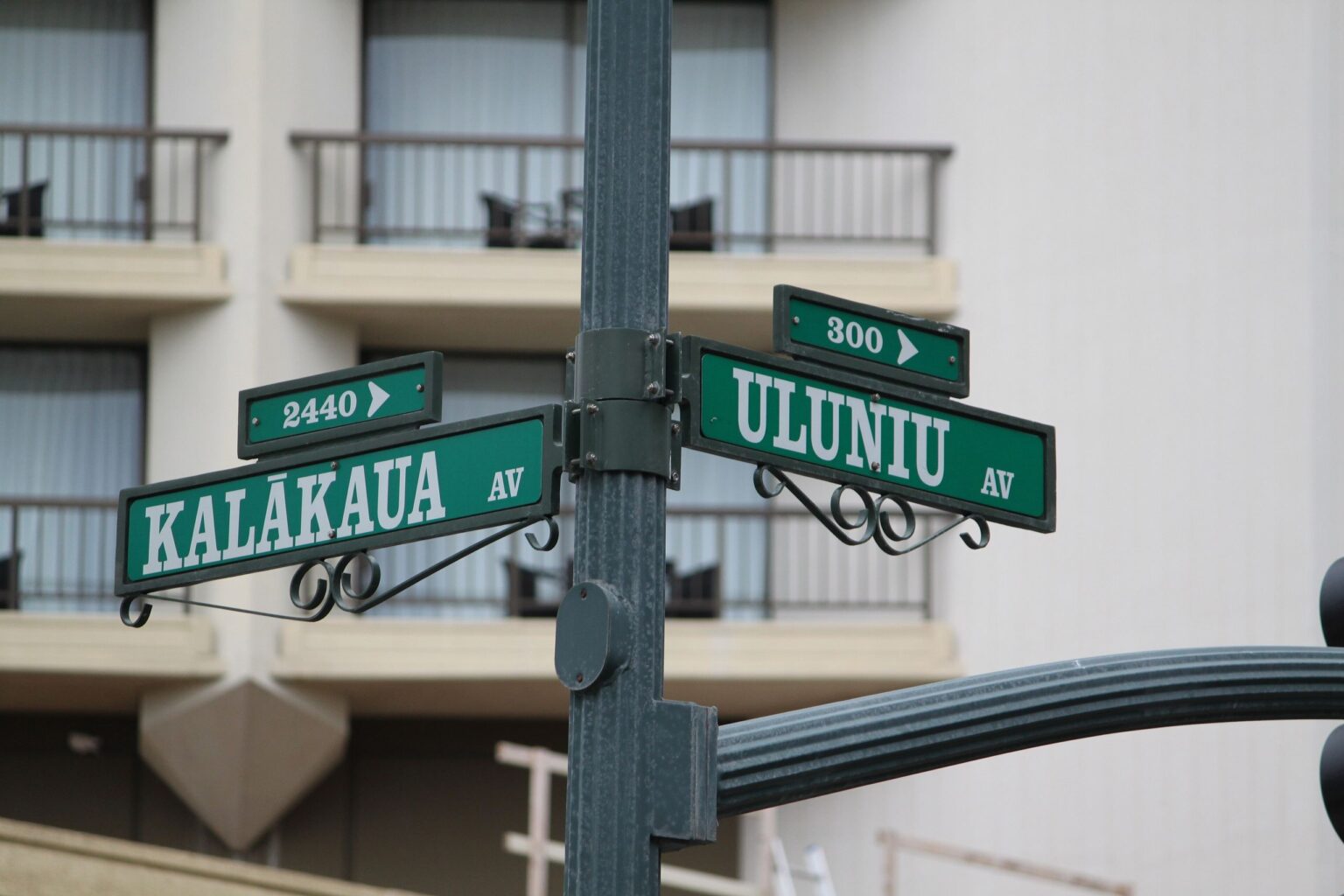
Kalākaua Avenue in Waikīkī, spelled with its kahakō. Photo: Jeremy from Sydney, Australia, CC BY 2.0, via Wikimedia Commons.
Quick Answer
Mahalo means thank you; mahalo nui loa is thank you very much. Aloha is love and compassion as well as hello and goodbye. A hui hou means until we meet again. Hawaiian has 13 letters, and it is one of Hawaiʻi’s two official state languages. Pidgin, the local creole, is a separate language.
What Mahalo Means, and How to Say Thank You
Mahalo means thanks or gratitude, and to thank. The standard Hawaiian dictionary, by Mary Kawena Pukui and Samuel Elbert, also gives it a second sense: admiration, praise, esteem and respect. So a mahalo carries a little regard along with the thanks.
To turn it up, add nui loa. The dictionary’s own example is mahalo nui loa, thank you very much. Say it the way you would say thanks anywhere: to the driver, the server, the person who holds the door. You do not need any other Hawaiian to use it, and nobody expects you to.
One sign trips up first-time visitors. You will see MAHALO stamped on trash cans and printed on receipts. It is still thank you (for using the bin, for your purchase), not the word for trash.
Aloha Means More Than Hello
Pukui-Elbert defines aloha as love, affection, compassion, mercy, sympathy and kindness, and also as a greeting used for both hello and goodbye. The greeting is the part visitors hear; the first meanings are the ones residents mean.
Hawaiʻi put that idea into state law in 1986. The Aloha Spirit statute (HRS 5-7.5) says aloha “is more than a word of greeting or farewell or a salutation” and defines it through five words whose first letters spell the word itself:
- Akahai: kindness, expressed with tenderness.
- Lōkahi: unity, expressed with harmony.
- ʻOluʻolu: agreeable, expressed with pleasantness.
- Haʻahaʻa: humility, expressed with modesty.
- Ahonui: patience, expressed with perseverance.
The law does not order anyone to be nice. It says state officials may consider the Aloha Spirit in their work. Pukui-Elbert adds that the time-of-day greetings, aloha kakahiaka (good morning) and aloha ahiahi (good evening), arrived after contact with Europeans.
A Hui Hou and Other Goodbyes
The goodbye you will hear most after aloha is a hui hou. Pukui-Elbert lists “a hui hou aku” as goodbye, till we meet again, built from hui (to meet) and hou (again). Add kākou, “we” meaning three or more people including the listener, and a hui hou kākou becomes until we all meet again.
The 13-Letter Hawaiian Alphabet
Hawaiian is written with 13 letters, according to the Hawaiʻi Tourism Authority: five vowels (a, e, i, o, u), seven consonants (h, k, l, m, n, p, w) and the ʻokina. Every word you read on Oʻahu is built from that set, which is why the state fish, the humuhumunukunukuāpuaʻa, looks the way it does. It became the state fish in 1985, lost the title when that law expired in 1990, and got it back for good in 2006.
The ʻokina is a glottal stop, the catch between the two halves of “uh-oh,” and it counts as a consonant (University of Hawaiʻi). It is written as an open single quote: ʻ. The kahakō is the line over a vowel, as in Kalākaua Avenue in the photo at the top of this page. It lengthens and stresses the vowel, and it can change the word. UH’s own example: depending on its marks, “pau” can mean completed, smudge, moist or skirt.
The marks are not decoration. Hawaiʻi with the ʻokina is the Hawaiian spelling of the islands’ name. The state’s legal name, set by the 1959 Admission Act, is written “Hawaii”, and changing the federal spelling would take an act of Congress (Hawaiʻi Board on Geographic Names). State law has allowed the ʻokina and kahakō in government documents since 1992, and since 2023 it has required state and county letterhead to spell Hawaiian words consistently (HRS 1-13.5).
Written Hawaiian is younger than the language. The first Hawaiian spelling book, the Pīʻāpā, was printed in 1822, and pīʻāpā is still the Hawaiian word for alphabet. This site writes Oahu and Waikiki without marks in titles, the way most visitors search for them; in the text of this guide we use the Hawaiian spellings.
What Oʻahu Place Names Mean
Most names on the map are Hawaiian descriptions. These meanings come from Place Names of Hawaiʻi (Pukui, Elbert and Mookini), the standard reference.
| Word | What it means |
|---|---|
| Waikīkī | Spouting water. Said to be named for swamps later drained to form the Ala Wai Canal. Our guide to Waikīkī’s beaches walks the shore section by section. |
| Honolulu | Protected bay. |
| Kailua | Two seas, probably two currents. |
| Hanauma | Curved bay, or hand-wrestling bay. See how to book Hanauma Bay. |
| Haleʻiwa | House of the frigate bird (ʻiwa birds were admired for their beauty). |
| Kalanianaʻole | The royal chief without measure. The highway and beach park are named for Prince Jonah Kūhiō Kalanianaʻole. |
| ʻEwa | Crooked. Also used as a direction term: toward ʻEwa, west of Honolulu. |
Myth check
Oʻahu is nicknamed The Gathering Place, but that is not what the name means. Place Names of Hawaiʻi refutes “gathering place” as a translation and gives no settled meaning for Oʻahu.
Words You Will See and Hear on Oʻahu
These turn up on signs, menus and in directions. Meanings are from Pukui-Elbert.
| Word | What it means |
|---|---|
| mauka | Inland, toward the mountains. Used as a direction. |
| makai | Toward the sea. The partner of mauka: “the makai side of the street.” |
| keiki | Child, children. |
| kāne | Man, husband. |
| wahine | Woman, wife (plural wāhine). |
| lānai | Porch, veranda, balcony. Hotel rooms list one. The island is spelled Lānaʻi. |
| kamaʻāina | Native-born, one born in a place; literally land child. A “kamaʻāina rate” is a resident price. |
| pau | Finished, all done. Used in Hawaiian and in Pidgin. |
| pūpū | Appetizer, hors d’oeuvre. Also the word for shells. |
| ʻono | Delicious, tasty; to crave. |
| pau hana | Literally, work is finished. Locals use it for any casual get-together after work, and bars use it for their after-work hours. |
- Eat the vocabulary: ʻono and pūpū are easiest to learn at the table. Our self-guided Oʻahu food tour and best poke on Oʻahu cover where.

Oʻahu’s Top Hawaiian Food and Scenic Tour
★★★★★ 4.9 · 170 reviews · From $165
Check AvailabilityWe may earn a commission if you book through this link, at no extra cost to you.
A Language That Came Back
In 1896 the Republic of Hawaii made English “the medium and basis of instruction” in all public and private schools (Act 57). The state Department of Education says the law essentially banned Hawaiian from the public school system, and by 1900 there were no Hawaiian language schools left. The rule stood for 90 years, until the Legislature lifted it in 1986 (ʻAha Pūnana Leo).
The revival started with preschools. Hawaiian language educators founded ʻAha Pūnana Leo in 1983 and opened the first Pūnana Leo, “nest of voices,” in Kekaha, Kauaʻi, in 1984. In 1987 the Department of Education opened its first Kaiapuni (Hawaiian immersion) classes at two elementary schools, and about 3,700 students were enrolled in Kaiapuni by the 2023-24 school year. Since 1978 the state constitution has named English and Hawaiian as Hawaiʻi’s two official languages.
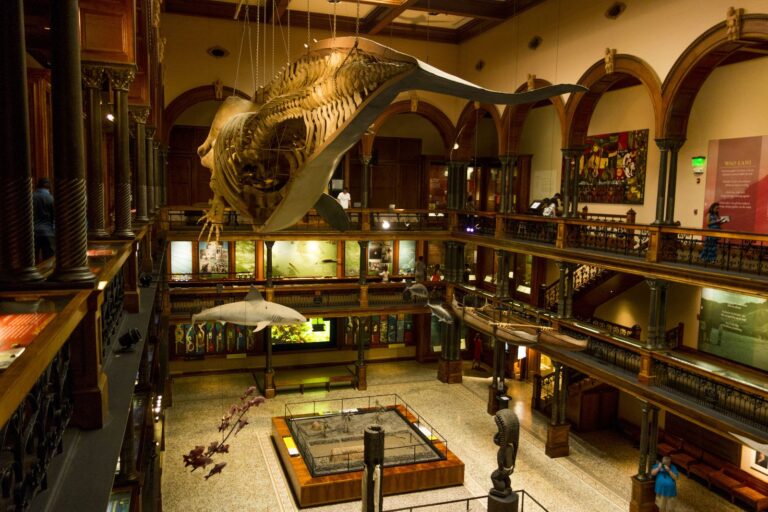
For the history behind the words, plan a few hours at Bishop Museum’s Hawaiian Hall, and see our things to do on Oʻahu guide for the rest of the island’s cultural sites.

Bishop Museum General Admission
★★★★★ 4.5 · 254 reviews · From $39
Check AvailabilityWe may earn a commission if you book through this link, at no extra cost to you.
Pidgin Is Its Own Language
The English-based talk you hear between many locals is not Hawaiian. It is Pidgin, which linguists call Hawaiʻi Creole: a full language that grew out of the sugar plantations in the late 1800s and early 1900s, when workers from China, Portugal, Japan, the Philippines, Korea and elsewhere worked alongside Hawaiians (University of Hawaiʻi at Mānoa). Its words come mostly from English, but Hawaiian shaped a lot of its grammar.
Pidgin showed up as its own language in the Census Bureau’s 2015 survey tables, which listed 350 languages spoken at home. Headlines called that official recognition. It was not: the Census lists languages, it does not make them official.
A few Pidgin words, with meanings from UH Mānoa’s Pidgin pages:
| Word | What it means |
|---|---|
| stink eye | A dirty look. |
| pau | Done. One of many Hawaiian words in Pidgin. |
| try | Please, as in “try wait.” |
| niele | Curious, nosy. |
| hemo | Take off, remove. |
| shibai | A lie, play acting. |
On signs
Look for Pidgin on storefronts and menus. UH’s own collection of Pidgin in public includes signs reading Howzit, Local Grindz and Broke da Mouth. Enjoy them; just do not imitate the accent back.
Using Hawaiian Words as a Visitor
Since 2024 the shaka, thumb and little finger out with the three middle fingers curled, has been Hawaiʻi’s official state gesture. The law ties it to sharing aloha, and notes that several origin stories exist, all of them placing its start in Hawaiʻi.
- Use mahalo and aloha freely. They are everyday words, not phrases reserved for locals.
- Try the place names. Say every vowel in Kalanianaʻole Highway and Waimānalo; a near miss lands better than a mangled shortcut.
- Keep kamaʻāina for residents. It means born here, so it is not a word to claim on a week’s visit.
- Listen to Pidgin, do not perform it. It is how people talk to each other, not a souvenir accent.
- Read the marks. The ʻokina and kahakō change meanings; Pukui-Elbert is free to search on Wehewehe. Getting around between the places you can now pronounce is in our Getting Around Oahu guide.
Hawaiian Words: Questions
What does mahalo mean?
Mahalo means thank you, thanks or gratitude. The Pukui-Elbert Hawaiian Dictionary also lists a second sense of admiration, praise and respect.
How do you say thank you very much in Hawaiian?
Mahalo nui loa. Nui loa intensifies mahalo, so the phrase means thank you very much.
What does a hui hou mean?
Until we meet again. Pukui-Elbert gives a hui hou aku as goodbye, till we meet again; adding kākou (we, three or more) makes a hui hou kākou, until we all meet again.
What does aloha mean?
Love, affection, compassion, mercy and kindness, and also hello and goodbye. Hawaiʻi’s Aloha Spirit law (1986) defines it through akahai, lōkahi, ʻoluʻolu, haʻahaʻa and ahonui.
How many letters are in the Hawaiian alphabet?
Thirteen: the vowels a, e, i, o, u, the consonants h, k, l, m, n, p, w, and the ʻokina, a glottal stop. A kahakō (macron) over a vowel lengthens it.
Is Pidgin the same as Hawaiian?
No. Pidgin, or Hawaiʻi Creole, is a separate language that grew out of the sugar plantations. Its words come mostly from English; Hawaiian is a Polynesian language.
Does Oʻahu mean the gathering place?
No. The Gathering Place is a nickname. Place Names of Hawaiʻi refutes it as a translation and gives no settled meaning for the name.
Is Hawaiian an official language?
Yes. Since 1978 the Hawaiʻi State Constitution has named English and Hawaiian as the state’s official languages.
Sources, checked Oct 2, 2026
- Pukui-Elbert Hawaiian Dictionary and Place Names of Hawaiʻi (Wehewehe, UH Hilo)
- HRS 5-7.5, Aloha Spirit
- Hawaiʻi State Constitution, Article XV (Legislative Reference Bureau)
- Act 57, 1896 (UH Mānoa College of Education)
- Ka Papahana Kaiapuni (Hawaiʻi Department of Education)
- ʻAha Pūnana Leo history
- What is Pidgin? (UH Mānoa)
- Pidgin in public (UH Mānoa)
- Census Bureau release CB15-185 (2015)
- Hawaiian language (Hawaiʻi Tourism Authority)
- ʻOkina and kahakō (University of Hawaiʻi)
- HRS 1-13.5, Hawaiian diacritical marks
- Hawaiʻi Board on Geographic Names minutes, Mar 2024
- 2006 Act 67, state fish
- 2024 SB3312 (Act 85), state gesture
- The Pīʻāpā (Punahou Bulletin)
Researched from the sources above, checked Oct 2, 2026. We never claim a visit we did not make; first-hand notes are marked as Stew’s. How we research and review.

Leave a Reply