
History & Culture · Pearl Harbor
What Happened at Pearl Harbor on December 7, 1941
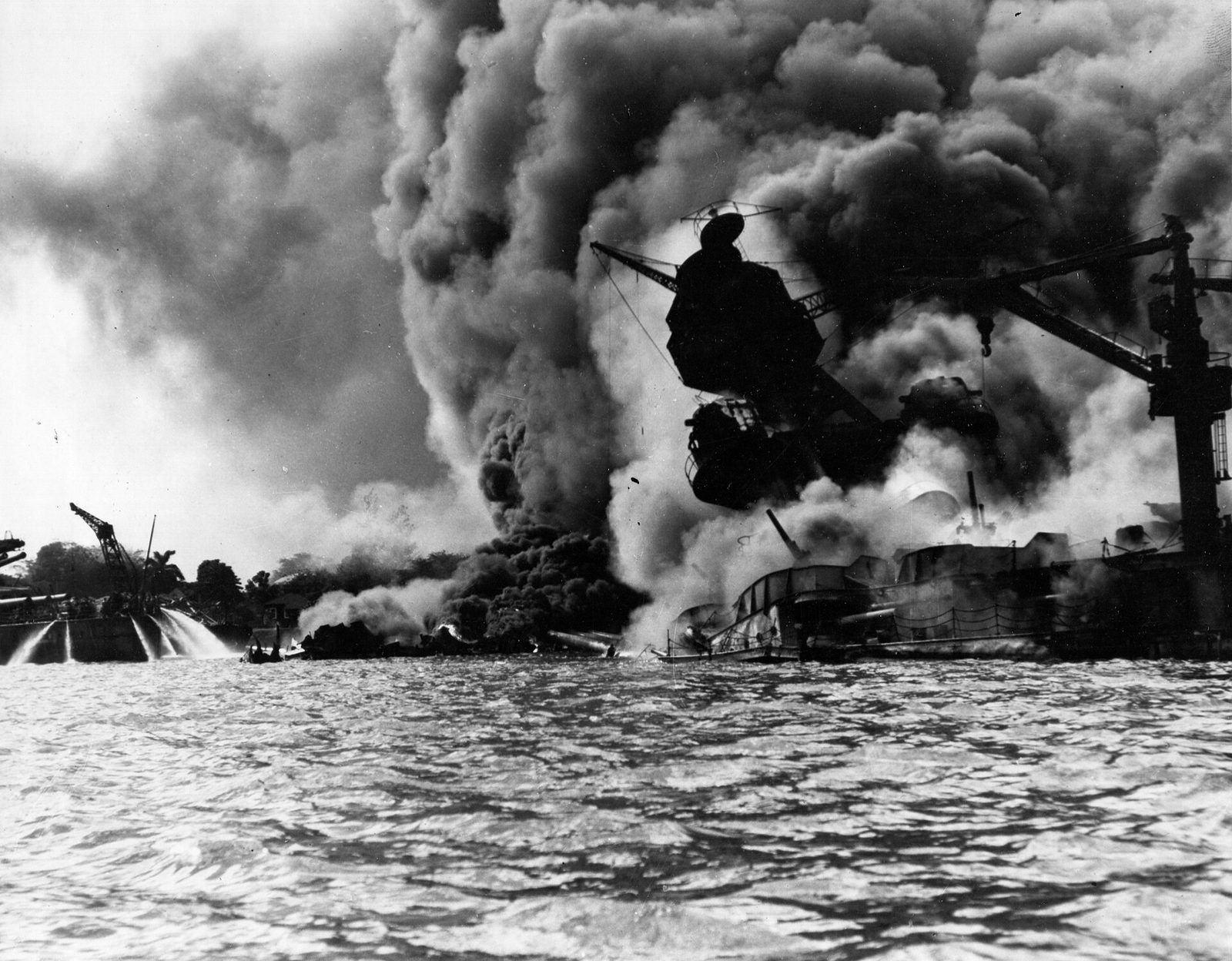
At 7:55 a.m. on Sunday, December 7, 1941, Japanese dive bombers appeared over Ford Island and Hickam Field as the signal for morning colors was going up. By mid-morning two waves of carrier planes had sunk or destroyed six ships of the U.S. Pacific Fleet, and 2,403 Americans were dead, 1,177 of them aboard the USS Arizona.
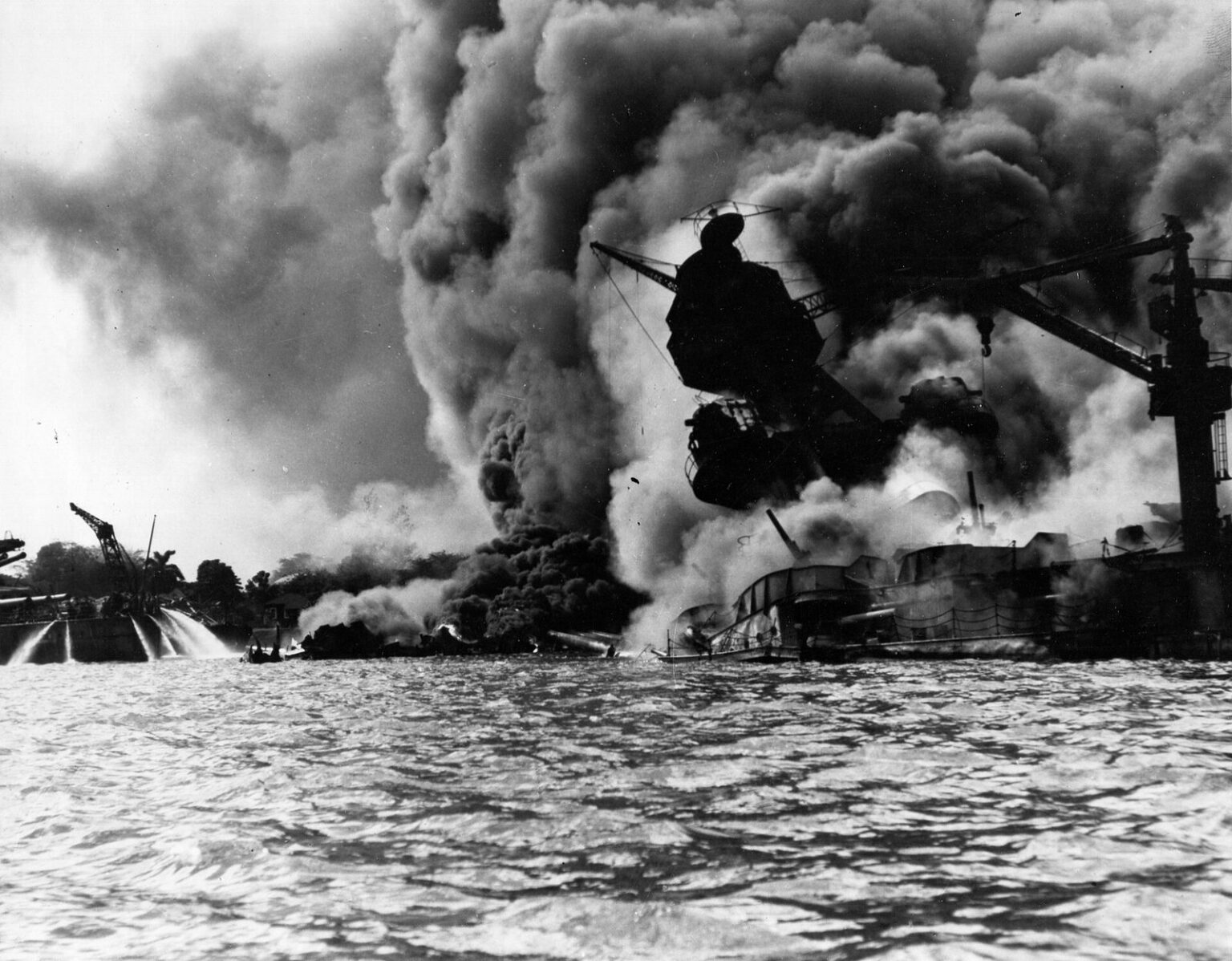
USS Arizona afire after the attack on December 7, 1941 (U.S. Navy photograph 80-G-19942, National Archives). Photo: U.S. Navy, Public domain, via Wikimedia Commons.
Quick Answer
Japan attacked to keep the U.S. Pacific Fleet out of its way. Cut off from American oil, Japan planned to seize Southeast Asia, and the fleet at Pearl Harbor could stop it. The first bombs fell at 7:55 a.m. Hawaiʻi time on Sunday, December 7, 1941. The Naval History and Heritage Command counts 2,403 Americans killed, 68 of them civilians, and 1,178 wounded. Congress declared war on Japan the next day.
Why Did Japan Attack Pearl Harbor? Oil and the Fleet
On November 26, 1941, in Washington, Secretary of State Cordell Hull handed Ambassador Nomura of Japan a paper headed “Tentative and Without Commitment.” Its third point read: “The Government of Japan will withdraw all military, naval, air and police forces from China and from Indochina.” (Foreign Relations of the United States)
In the Kurile Islands the date was also November 26. That day Vice Admiral Chuichi Nagumo’s fleet left the remote anchorage of Tankan Bay for Hawaiʻi “in strictest secrecy,” six heavy aircraft carriers and 24 supporting vessels, according to the Naval History and Heritage Command.
The quarrel was over China. Japan had been at war there since July 7, 1937, when Chinese and Japanese troops clashed at the Marco Polo Bridge near Beijing. The State Department’s Office of the Historian calls the United States “the main supplier of the oil, steel, iron, and other commodities needed by the Japanese military” while that war dragged on.
On September 27, 1940, Japan signed the Tripartite Pact with Germany and Italy. It wanted what it called the Southern Resource Area, which the National Park Service describes as Southeast Asian countries rich in oil, tin, iron and rubber. When Japanese troops moved into Indochina under an agreement with Vichy France, Washington froze Japanese assets in American banks and put a full embargo on exports to Japan.
By the Park Service’s count, Japan had “only a six-month supply of strategic fuel available for its armed forces.”
Japan was poor in natural resources, and the Navy’s historians write that its government saw the oil embargo as “a threat to the nation’s survival.” Talks went on in Washington. Any deal Americans would accept meant Japan leaving China, and that condition, in the Office of the Historian’s words, “was unacceptable to Japan’s military leaders.”
So Japan’s leaders resolved to take Southeast Asia by force, knowing it meant war with the United States. In the words of the Naval History and Heritage Command, “The problem with the plan was the danger posed by the U.S. Pacific Fleet based at Pearl Harbor.”
Admiral Isoroku Yamamoto, commander in chief of the Combined Fleet, proposed to hit that fleet at anchor and immobilize it at the outset of the war with a surprise attack. The naval general staff gave his plan final approval in October 1941. Facing serious shortages and unable to retreat, Japan’s leaders, the Office of the Historian writes, “came to the conclusion that they had to act swiftly.”
Washington did not expect it. American leaders “doubted that Japan had the military strength to attack the U.S. territory.”
What Happened at Pearl Harbor: The Morning in Order
The first shots were American. Before dawn five Japanese midget submarines, each carried by a larger submarine, were launched near the harbor entrance. The destroyer USS Ward found one trailing the cargo ship Antares toward Pearl Harbor, opened fire, dropped depth charges and reported to the Fourteenth Naval District: “We have attacked, fired upon, and dropped depth charges on a submarine operating in defensive sea areas.” (USS Ward action report)
The planes were more than an hour away. More than 200 miles north of Oʻahu, the carriers Akagi, Kaga, Sōryū, Hiryū, Shōkaku and Zuikaku had launched a first wave of more than 180 aircraft in the dark.
At the Opana radar site, a knoll near Kahuku Point on the North Shore, Privates Joseph Lockard and George Elliott had a Sunday training watch that ended at 7 o’clock. They kept the set on. “We figured that we might as well play around,” Lockard told the Army Pearl Harbor Board, “because the truck had not come in yet to take us back for chow.”
At two minutes after seven by the unit’s clock, a very large formation of aircraft appeared, coming in from the north. Lockard testified that they picked it up at 136 miles; the Park Service timeline gives 7:02 a.m. and roughly 130 miles.
Elliott telephoned the information center at Fort Shafter, where the staff had already gone to breakfast, and the call went to Lieutenant Kermit Tyler. A flight of 12 B-17 bombers was due at Hickam Field from California that morning. “I thought it most probable that it would be the B-17’s which were coming from the mainland,” Tyler testified. His answer to Opana: “I told him not to worry about it.”
At 7:55, as the preparatory signal for eight o’clock colors was going up, Japanese dive bombers appeared over Hickam Field and Ford Island (CINCPAC report). They struck the Ford Island seaplane ramp first, wrecking hangars and PBY patrol planes. At 7:58 Patrol Wing Two broadcast a plain-language warning to all ships present: an air raid on Pearl Harbor, and not a drill.
The Army’s planes were easy to hit. In late November Lieutenant General Walter Short had ordered an alert against sabotage, so aircraft were bunched where they could be guarded, not dispersed. At Wheeler Field the fighters stood in rows in front of the hangars, and the Park Service counts 83 aircraft destroyed there. At Hickam a bomb hit the mess hall during breakfast and killed 35 men. Across the island at Kāneʻohe Bay, all but six of 33 PBY flying boats were destroyed.
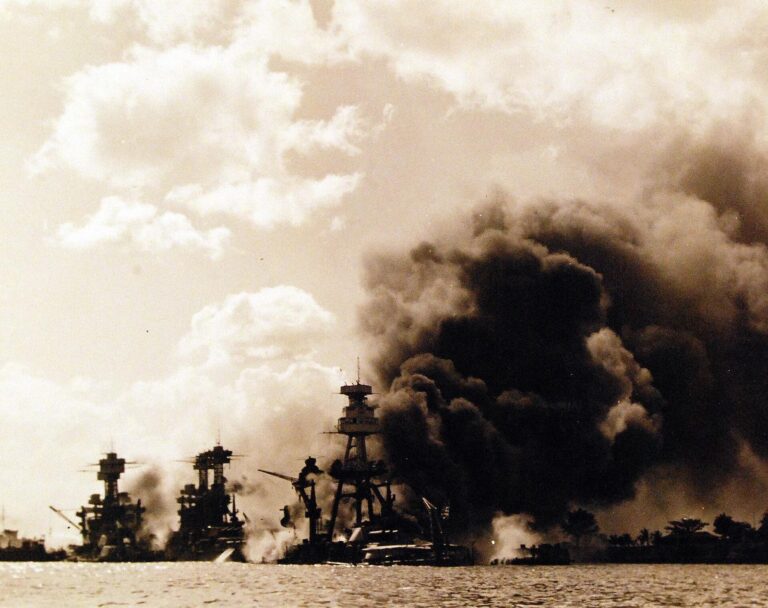
Torpedo planes went for Battleship Row, the moorings along Ford Island’s southeast side. The Oklahoma took as many as nine torpedoes and capsized at her berth within minutes; 429 of her officers, sailors and Marines died. The West Virginia, hit by torpedoes and bombs, settled to the bottom on an even keel and wedged the Tennessee against her quays. The California sank at her berth. On the far side of Ford Island the old target ship Utah capsized to port in about ten minutes, and 58 of her crew died.
Then the Arizona.
One of the bombs that hit her, estimated in the CINCPAC damage report at 2,000 pounds, exploded her forward magazines. The blast killed 1,177 of the 1,512 men on board, about half of all the Americans who died that day.
Some pilots got into the air. Two lieutenants at Wheeler phoned the small Army field at Haleʻiwa, which the Japanese did not know about, to have their P-40s fueled and warmed up, then raced there and took off. Lieutenants George Welch and Kenneth Taylor, P-40 pilots who took off during the attack, later received the Distinguished Service Cross; Welch had four confirmed kills and Taylor two. At Kāneʻohe Bay, Chief Aviation Ordnanceman John Finn manned a .50-caliber machine gun on an exposed part of the parking ramp and kept firing though wounded many times. He received the Medal of Honor.
The 12 B-17s from California arrived in the middle of it, unarmed and low on fuel. Most landed at Hickam and were attacked on the ground.
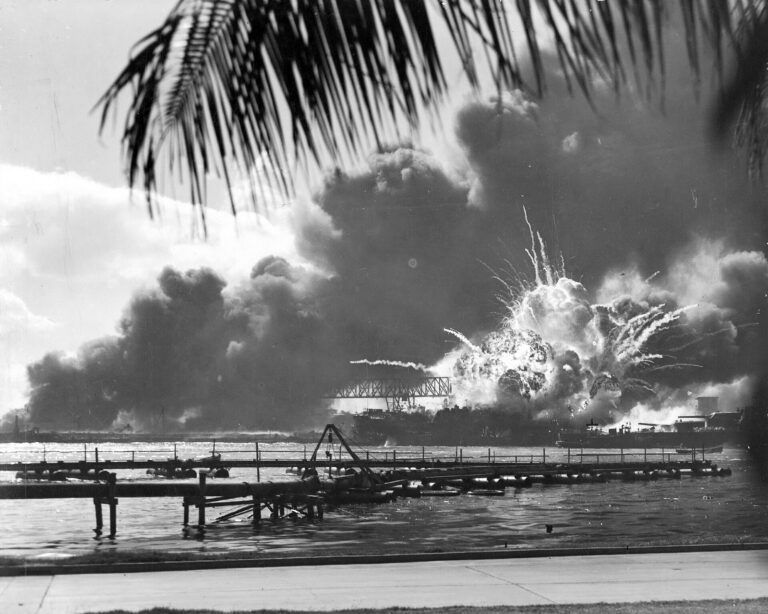
A second wave of 167 aircraft, with no torpedo planes, did more damage to the airfields, struck targets around the Navy Yard and went after the Nevada, the only battleship to get under way. She headed down the channel afire from several bomb hits. On orders from the harbor control tower she beached herself at Hospital Point, and the channel stayed clear. In the floating drydock at the Navy Yard, fire reached the forward magazines of the destroyer Shaw and blew off her bow.
By mid-morning the last Japanese planes had left to return to their carriers. Japan lost 29 aircraft and 55 airmen. All five midget submarines were lost, and nine of their ten crewmen died. The tenth, Ensign Kazuo Sakamaki, washed ashore at Waimānalo Beach near Bellows Field and was captured on the sand.
He became prisoner of war No. 1.
How Many People Died at Pearl Harbor?
The Naval History and Heritage Command counts 2,403 Americans killed and 1,178 wounded. The Arizona’s 1,177 dead are about half of that toll.
| Service | Killed or missing | Wounded |
|---|---|---|
| Navy | 2,008 | 710 |
| Marine Corps | 109 | 69 |
| Army | 218 | 364 |
| Civilian | 68 | 35 |
| Total | 2,403 | 1,178 |
Source: Naval History and Heritage Command.
NHHC says most of the 68 civilians were killed by improperly fused anti-aircraft shells landing in Honolulu. The Army’s official history says the “bombs” that fell on the city were Navy 5-inch antiaircraft shells that had failed to detonate in the air, and that they started three major fires. The National Park Service names 49 civilians killed and 35 wounded on Oʻahu. The two agencies’ counts differ.
NHHC counts 188 Navy, Marine Corps and Army Air Force planes destroyed. It lists six ships sunk or destroyed: the Arizona, Oklahoma, California, West Virginia, the minelayer Oglala and the Utah. All were raised and rebuilt except the Arizona, Oklahoma and Utah, and the Oklahoma was raised but never rebuilt.
| Battleship | Berth | December 7 | Killed | Afterward |
|---|---|---|---|---|
| USS Arizona | F-7 | A bomb exploded her forward magazines; sank at her berth | 1,177 | Never returned; struck from the Navy list Dec 1, 1942 |
| USS Oklahoma | F-5, outboard | Up to nine torpedoes; capsized within minutes | 429 | Righted, decommissioned Sept 1, 1944; sank under tow in 1947 |
| USS West Virginia | F-6, outboard | Torpedoes and bombs; settled to the bottom | 106 | Refloated May 17, 1942; sailed to rejoin the fleet Sept 14, 1944 |
| USS California | F-3 | Two aircraft torpedoes; sank at her berth | No settled figure | Refloated March 25, 1942; rebuilt by Jan 31, 1944 |
| USS Utah | F-11 | Torpedoed; capsized to port in about ten minutes | 58 | Never returned to service |
| USS Nevada | F-8 | Torpedoed, got under way, beached at Hospital Point | No settled figure | Repaired and rebuilt; survived the 1946 Bikini atomic tests |
| USS Tennessee | F-6, inboard | Bomb hits; pinned against her quays | 5 | Repaired at Puget Sound Navy Yard |
| USS Maryland | F-5, inboard | Two bomb hits on the forecastle | 4 | Back from Puget Sound, repaired and modernized, Feb 26, 1942 |
| USS Pennsylvania | Drydock No. 1 | One bomb hit | No settled figure | Undocked Dec 12, 1941 |
Sources: CINCPAC damage report, NHHC ship histories (DANFS), National Park Service.
Of the eight battleships in the harbor that morning, six were repaired and went back to sea.
What Happened Next: The Note and the Declaration of War
Ambassador Nomura had orders to deliver Japan’s reply to Hull at 1 p.m. Washington time, which was 7:30 a.m. in Hawaiʻi. Hull received him and Saburo Kurusu at 2:20 (State Department memorandum).
The reply said the American proposal of November 26 “ignores Japan’s sacrifices in the four years of the China Affair, menaces the Empire’s existence itself and disparages its honour and prestige.” Its last sentence broke off the talks: “The Japanese Government regrets to have to notify hereby the American Government that in view of the attitude of the American Government it cannot but consider that it is impossible to reach an agreement through further negotiations.”
Hull told Nomura: “In all my fifty years of public service I have never seen a document that was more crowded with infamous falsehoods and distortions.” His statement that day said the attack had taken place before the ambassador delivered his government’s final statement.
In Honolulu, Governor Joseph B. Poindexter telephoned President Roosevelt, who approved martial law. That afternoon the governor signed proclamations handing his powers to the Army’s commanding general and suspending habeas corpus. The Army ordered a blackout every night until further notice. Some degree of martial law lasted until October 24, 1944.
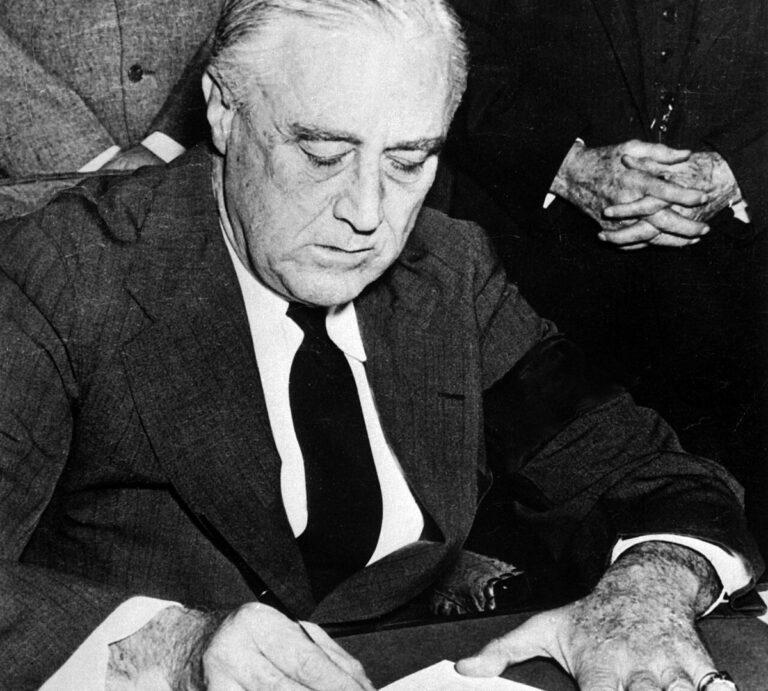
On December 8 Roosevelt addressed a joint session of Congress and, by radio, the nation. In his first typed draft he had called December 7 “a date which will live in world history.” He changed it by hand. The speech said the United States “was suddenly and deliberately attacked by naval and air forces of the Empire of Japan” on “a date which will live in infamy.”
Congress passed a joint resolution declaring that a state of war existed with Japan, and Roosevelt signed it that afternoon. When Germany stood by its ally and declared war on the United States, the country was at war in Europe and Asia both.
Where to See Pearl Harbor History Today
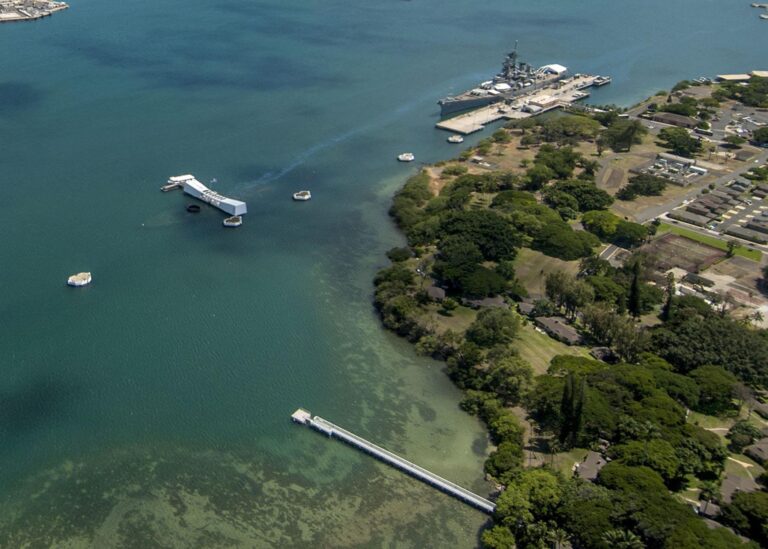
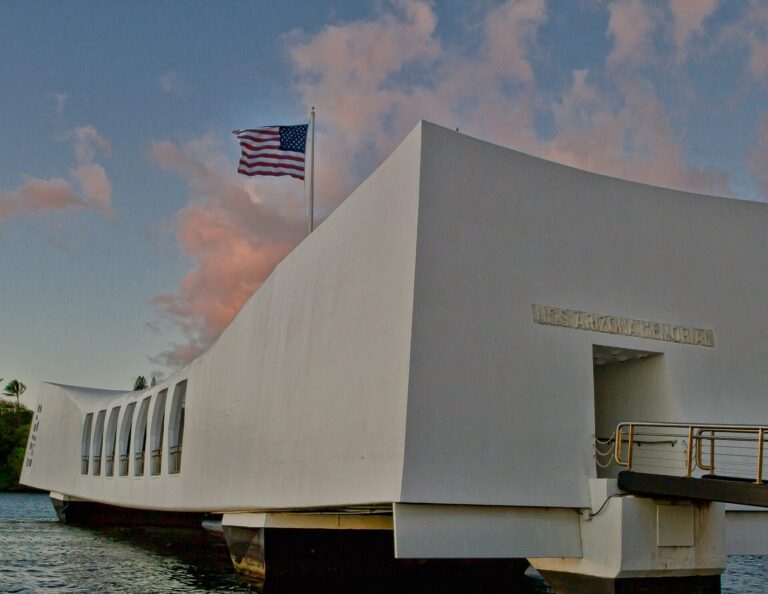
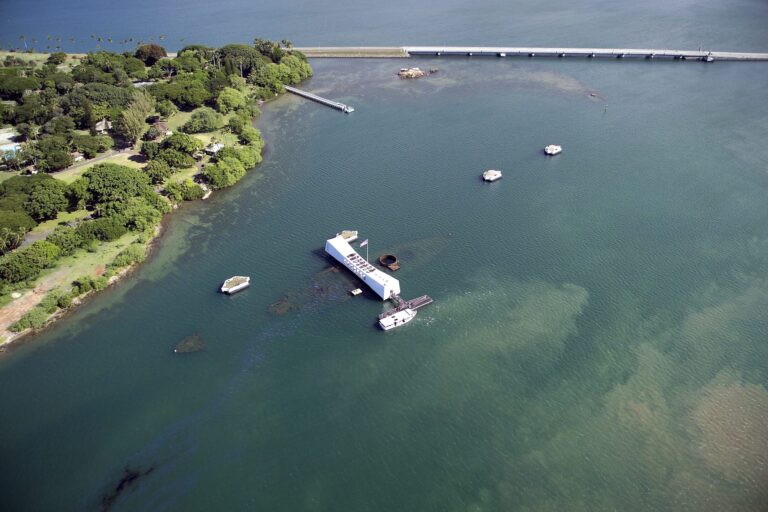
The Arizona still lies where she sank off Ford Island. The National Park Service calls her the final resting place for over 900 of the 1,177 crewmen who died aboard, and it has written that drops of oil still leak from the ship, “the tears of the fallen.”
Visits start at the Pearl Harbor National Memorial Visitor Center, which is free and open daily from 7 a.m. to 5 p.m., closed on Thanksgiving, Christmas and New Year’s Day. The USS Arizona Memorial program is free to reserve on Recreation.gov, with a $1 fee per ticket, and takes about 45 minutes, including 10 to 15 minutes on the memorial. Parking is $7 a day (National Park Service, as of October 2026). Our guide to Pearl Harbor tickets has the booking steps, and visiting Pearl Harbor covers the day itself.
The Battleship Missouri Memorial, the submarine USS Bowfin and the Pearl Harbor Aviation Museum are not run by the Park Service, which calls them “separate and independent sites.” The USS Utah and USS Oklahoma memorials stand on Ford Island, and the public can reach the Utah only on the Park Service’s Ford Island Bus Tour, which runs Mondays, Wednesdays and Fridays.
Pearl Harbor is on Oʻahu’s south shore, west of Honolulu; getting to Pearl Harbor from Waikiki compares the ways to get there, and Pearl Harbor tours from Waikiki are compared side by side. The Pearl Harbor map lays out every site, and the National Memorial Cemetery of the Pacific sits in Punchbowl Crater above downtown Honolulu.
December 7, 2026 marks 85 years. Our Pearl Harbor Remembrance Day guide has the anniversary.
Pearl Harbor Attack Questions
Why did Japan attack Pearl Harbor?
To keep the U.S. Pacific Fleet from stopping Japan as it seized the oil-rich territories of Southeast Asia. An American embargo had left Japan, poor in natural resources, with what the National Park Service calls a six-month supply of strategic fuel for its armed forces.
What happened at Pearl Harbor?
On the morning of December 7, 1941, two waves of Japanese carrier planes attacked the Pacific Fleet and the airfields on Oʻahu. Six ships were sunk or destroyed, 188 U.S. planes were destroyed and 2,403 Americans were killed.
How many people died at Pearl Harbor?
The Naval History and Heritage Command counts 2,403 Americans killed or missing: 2,008 Navy, 109 Marine Corps, 218 Army and 68 civilians. Japan lost 55 airmen and nine midget submarine crewmen.
What time did the Pearl Harbor attack start?
Japanese dive bombers appeared over Hickam Field and Ford Island at 7:55 a.m. Hawaiʻi time. The Opana radar had picked up the incoming planes at 7:02 a.m.
Was the attack on Pearl Harbor a surprise?
Yes, though there were warnings that morning. USS Ward attacked a midget submarine off the harbor entrance more than an hour before the planes arrived, and the Opana radar contact was taken for a flight of B-17s due from California.
Which ships were sunk at Pearl Harbor?
The Naval History and Heritage Command lists the Arizona, Oklahoma, California, West Virginia, Oglala and Utah as sunk or destroyed. All but the Arizona, Oklahoma and Utah were raised and rebuilt.
When did the United States declare war on Japan?
On December 8, 1941, the day after the attack. Congress passed the joint resolution and President Roosevelt signed it that afternoon.
Can you visit Pearl Harbor today?
Yes. The Pearl Harbor National Memorial Visitor Center is free, and the USS Arizona Memorial program is free to reserve on Recreation.gov with a $1 fee per ticket.
Sources, checked Nov 15, 2026
- FRUS, Japan, 1931–1941, Volume II, Document 409: Document Handed by the Secretary of State to the Japanese Ambassador
- NHHC, The Pearl Harbor Attack, 7 December 1941 – Overview (online reading room)
- U.S. Department of State, Office of the Historian, Japan, China, the United States and the Road to Pearl Harbor, 1937–41
- NPS, Pearl Harbor National Memorial, Pacific Battles
- NPS, The Pearl Harbor Attack (excerpt of the Submerged Cultural Resources Study)
- NHHC, H-Gram 001, H-001-2 USS Ward (Samuel J. Cox, Director NHHC)
- NHHC online action reports, USS Ward
- NHHC, Japanese Forces in the Pearl Harbor Attack (photo collection introduction)
- NPS, National Historic Landmark nomination, Opana Radar Site (NPS Form 10-900)
- NPS, Pearl Harbor National Memorial, Remembering Pearl Harbor: Minute by Minute
- govinfo.gov, Pearl Harbor Attack, Hearings before the Joint Committee, Part 27
- NPS, Hickam Field
- NHHC online reading room, CinCPac Report – Pearl Harbor
- U.S. Army Center of Military History, Guarding the United States and Its Outposts
- NPS Pearl Harbor National Memorial, Battlefield O’ahu
- NHHC online action reports, Patrol Wing Two Action Report
- NPS, National Historic Landmark nomination, Wheeler Field (NPS Form 10-900, Item 8)
- NPS, Wheeler Field (Aviation: From Sand Dunes to Sonic Booms)
- NHHC, Naval Air Station, Kaneohe Bay (Pearl Harbor Raid photo series)
- NHHC, Battleship Row During the Pearl Harbor Attack
- NHHC, Attacks off the West Side of Ford Island
- NPS, Pearl Harbor National Memorial, USS Oklahoma
- CINCPAC report Enclosure (C), Damage Report for Ships (NHHC Online Reading Room)
- NPS, USS Oklahoma Memorial
- NHHC DANFS, West Virginia II (BB-48)
- NHHC DANFS, Tennessee V (Battleship No. 43)
- NPS, USS Utah Memorial
- NHHC DANFS, Arizona II (Battleship No. 39)
- U.S. Air Force, ‘Japanese surprise attack on Hawaii’ (Air Force Print News, 7 Dec 2006)
- NHHC, Medal of Honor Citation: Chief Aviation Ordnanceman John William Finn, USN
- NHHC, Japanese Aircraft During and After the Raid
- NHHC DANFS, Nevada II (Battleship No. 36)
- NHHC, Attacks in the Navy Yard Area
- NHHC, H-Gram 001, H-001-1 Pearl Harbor, 7 December 1941 (Samuel J. Cox, Director NHHC)
- NHHC, Pearl Harbor Attack (topic page)
- NHHC / National Museum of the U.S. Navy, Fact Sheet: Pearl Harbor: Aftermath
- NPS, Pearl Harbor National Memorial, Civilian Casualties
- NHHC, Ships and District Craft Present at Pearl Harbor, 0800 7 December 1941
- NHHC Online Action Reports, USS Tennessee (BB-43) report
- NHHC Online Action Reports, USS Pennsylvania (BB-38) report of 16 Dec 1941
- NHHC Online Action Reports, USS Utah (AG-16) report
- NHHC DANFS, Oklahoma (Battleship No. 37)
- NHHC DANFS, California V (BB-44)
- NHHC DANFS, Utah I (Battleship No. 31, AG-16)
- NHHC DANFS, Maryland III (Battleship No. 46)
- NHHC DANFS, Pennsylvania III (Battleship No. 38)
- NPS, Pearl Harbor National Memorial, Battleship Row
- FRUS, Japan, 1931–1941, Volume II, Document 419: Memorandum of a Conversation, December 7, 1941
- FRUS, Japan, 1931–1941, Volume II, Document 420: Memorandum Handed by the Japanese Ambassador
- FRUS, Japan, 1931–1941, Volume II, Document 421: Statement by the Secretary of State, December 7, 1941
- National Archives, Milestone Documents, Joint Address to Congress Leading to a Declaration of War Against Japan
- National Archives, Prologue (Winter 2001), Crafting the Day of Infamy Speech
- govinfo.gov, 55 Stat. 795, Public Law 328 (S.J. Res. 116), 77th Cong., Dec. 8, 1941
- NPS, Pearl Harbor National Memorial, USS Arizona
- NPS, Underwater at the USS Arizona
- NPS, Pearl Harbor National Memorial, Basic Information (updated 2026-07-30)
- NPS, USS Arizona Memorial Programs (updated 2026-05-07)
- NPS, Operating Hours & Seasons (updated 2025-10-09)
- NPS, Pearl Harbor National Memorial, Frequently Asked Questions
- Battleship Missouri Memorial (official site)
- USS Bowfin / Pacific Fleet Submarine Museum (official site)
- Pearl Harbor Aviation Museum (official site)
- NPS, Ford Island Bus Tour (updated 2025-10-16)
Researched from the sources above, checked Nov 15, 2026. We never claim a visit we did not make; first-hand notes are marked as Stew’s. How we research and review.
Leave a Reply