
Parks · North Shore
Waimea Bay Beach Park: Summer Calm, Winter Giants
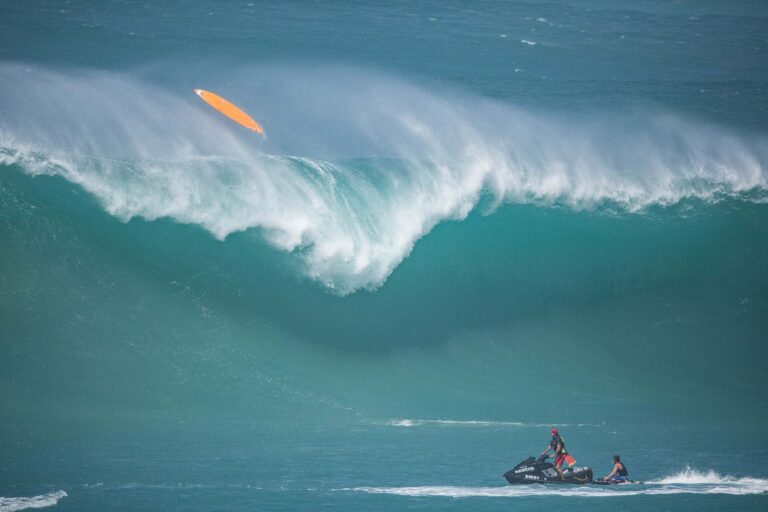
Waimea Bay is two beaches in one. In summer the State calls the North Shore flat to small and the bay is a place to swim. In winter it gets “consistent huge and dangerous swells,” with surf the City has logged at up to 30-foot faces. Here is how each season works, what the shorebreak and currents do, what the official sources say about the Rock, and the hours, lifeguards, parking and rules.
Some links on this page are affiliate links. If you book or buy through them, we may earn a commission at no extra cost to you.
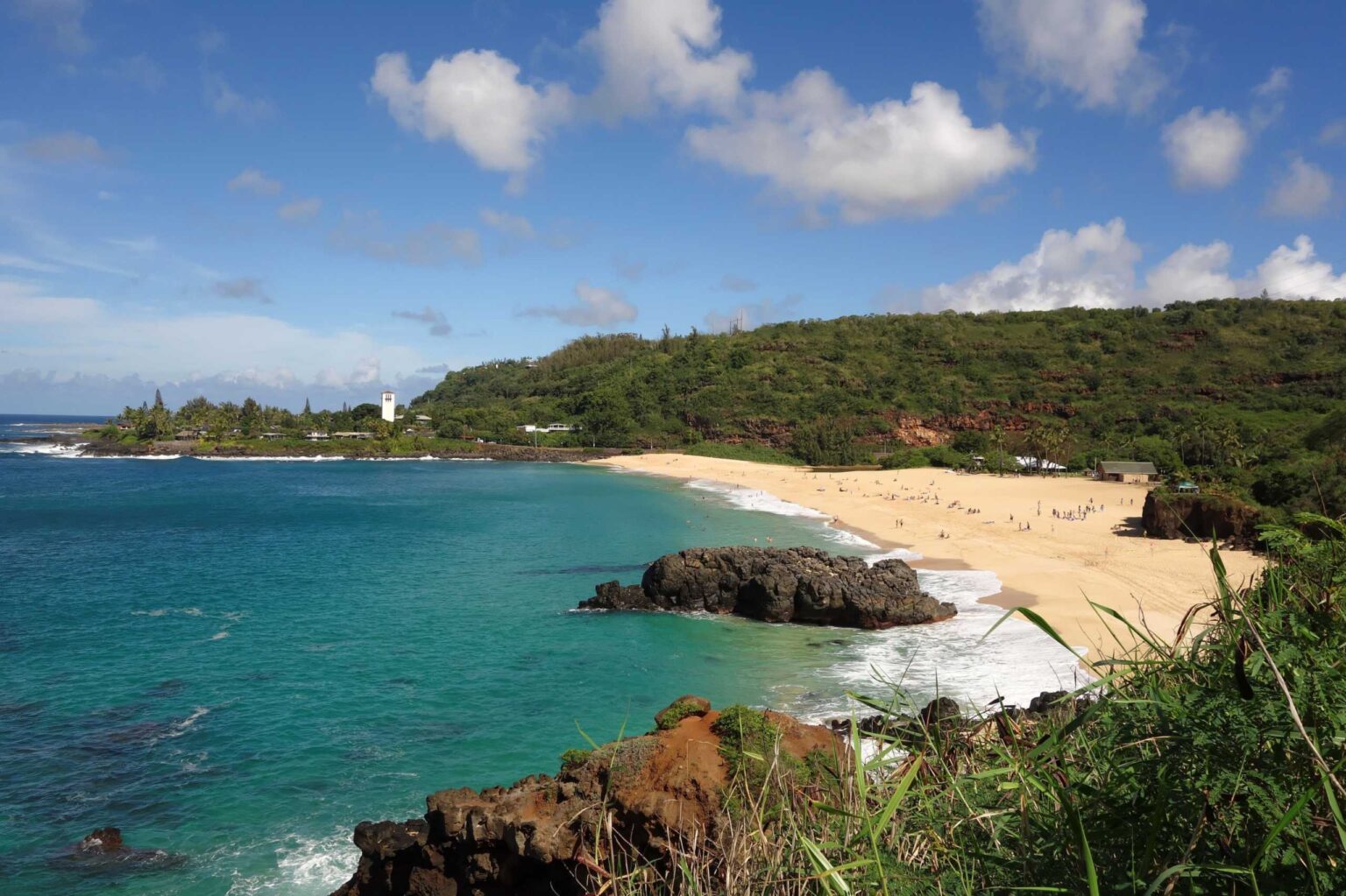
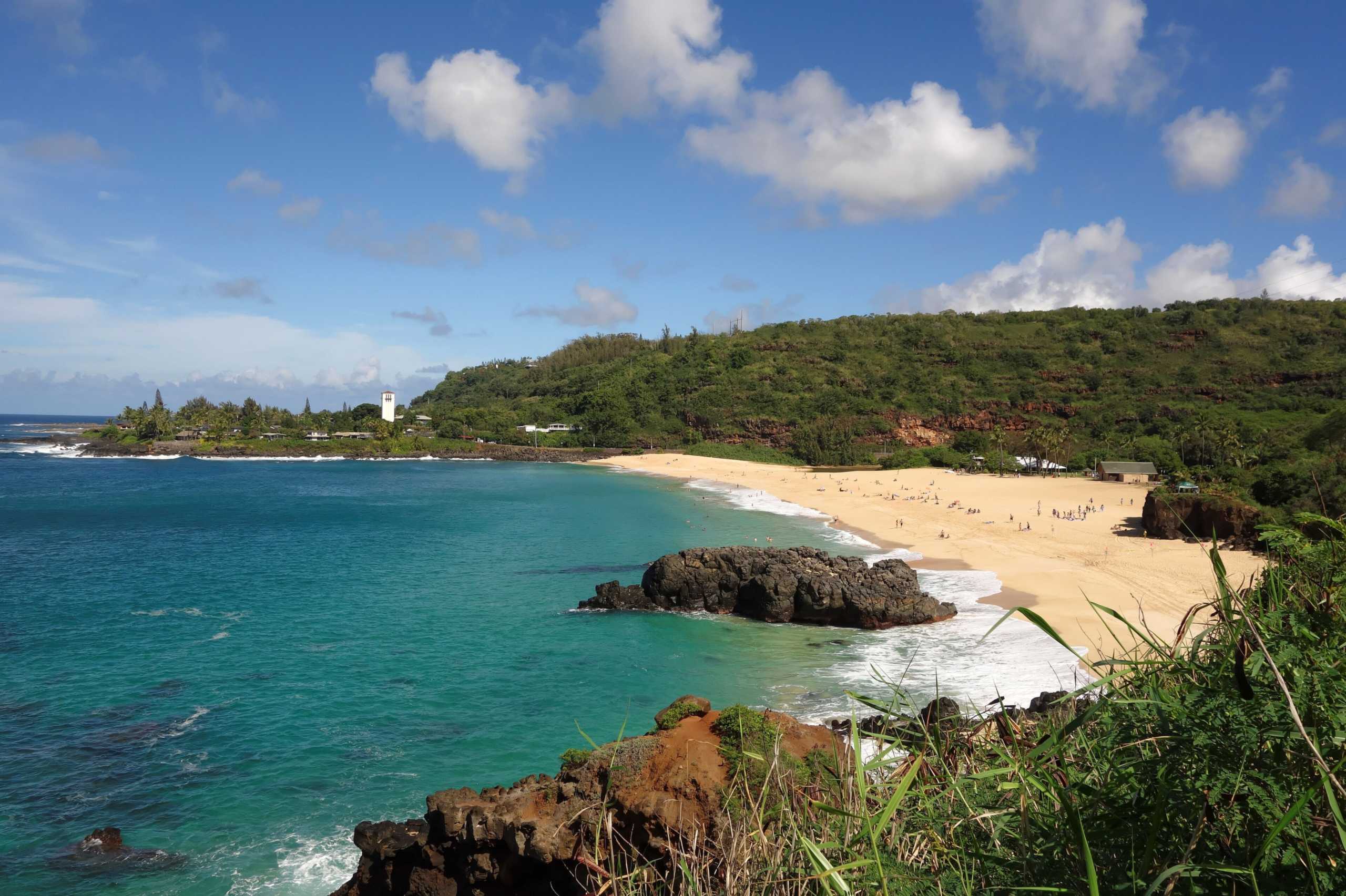
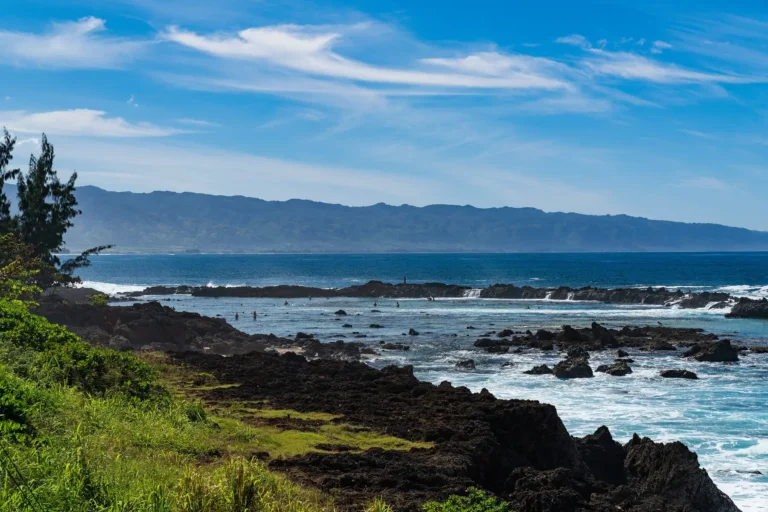
Waimea Bay from the highway on a calm day. Photo: Daniel Ramirez, CC BY 2.0, via Wikimedia Commons.
Quick Answer
Open 5 a.m. to 10 p.m. (the City closes the park 10 p.m. to 5 a.m.). Tower 29 is staffed 8 a.m. to 6:30 p.m. daily. Summer is the swimming season; in winter the State says novice surfers and swimmers of any skill level should stay out of the water at North Shore beaches during high surf, so come to watch from the sand. Shorebreak and strong currents are listed hazards at this beach. Parking is tight, there are no dogs, and the bus from Waikīkī takes hours.
- Hours
- Closed 10 p.m. to 5 a.m.; open 5 a.m. to 10 p.m.
- Lifeguards
- Tower 29, 8 a.m. to 6:30 p.m. daily
- Parking
- Beach park lot; the City publishes no stall count
- Setting
- At the mouth of the Waimea River, across from Waimea Valley
- Amenities
- Restrooms, showers, picnic area
- Dogs
- Not allowed
- From Waikīkī
- About 39 miles; about an hour without traffic, by our count
- Managed by
- City Parks and Recreation; lifeguards by Honolulu Ocean Safety
Facts from the City’s lifeguard tower and park-closure pages and HawaiiBeachSafety.com, checked Oct 13, 2026.
Summer Calm, Winter Giants
The bay cut along the reef off its northeast point, where the big waves break. Depths from NOAA NCEI, vertical scale exaggerated. Map data © OpenStreetMap contributors.
Hawaii Ocean Safety lays out the split on its surf seasons page: north shores run flat to small in summer, and in winter they get consistent huge and dangerous swells. Waimea Bay sits at the mouth of the Waimea River, across the highway from Waimea Valley (HawaiiBeachSafety.com). The National Weather Service issues a High Surf Advisory for north-facing shores at 15 feet and a Warning at 25 (NWS).
Those numbers show up in the City’s own logs. On November 13, 2022, with surf “said to be 18-20 foot faces,” Honolulu Ocean Safety rescued 32 people on the North Shore, most of them at Waimea Bay (HESD). On January 2, 2023, surf at Waimea “got up to 30 foot faces” (HESD). The bay’s big-wave reputation is old: the City’s Ocean Safety history page names Eddie Aikau the first City lifeguard to work the North Shore, based at Waimea Bay every day (Honolulu Ocean Safety).
How to check before you go. Read the National Weather Service surf forecast the night before, open the bay’s page on HawaiiBeachSafety.com (it warns that conditions are “not always real-time”), and watch the City’s HNL.info alerts for lifeguard tower closures (Ocean Safety). Then ask the Tower 29 guard. Our Is it safe to swim on Oahu today guide covers the island-wide version, and where to watch the big waves covers the winter side.
| Season | North Shore waves | What it means for a visit |
|---|---|---|
| Summer | “Flat-to-small waves” (State of Hawaii) | The swimming and snorkeling season, with Tower 29 staffed |
| Winter | “Consistent huge and dangerous swells” (State of Hawaii) | Watch from dry sand; the State says swimmers of any skill level should avoid the water in high surf |
About the Wave: Why Waimea Gets So Big
Where it comes from. The National Weather Service says the biggest North Shore surf comes from “major storms far to the northwest of Hawaii,” and that typical winter swells travel 2,000 miles or more to get here (NWS). The swells that make Waimea break arrive with periods that “may be as much as 22 to 30 seconds” (University of Hawaiʻi). Nothing slows them on the way in: “there is no continental shelf,” in Hawaii Ocean Safety’s words (Hawaii Ocean Safety).
Why it stands up here. At Waimea “the ocean floor rises abruptly, and deep-water swells change rapidly to steep-crested waves” (University of Hawaiʻi). A 2007 study by researchers at NOAA and the University of Hawaiʻi found that surfers catch the wave about 50 to 100 meters outside the point on the northeast side and ride toward “the safety of the deep waters in the center of the bay” (Journal of Coastal Research). NOAA’s seafloor model shows the step: off that point the bottom climbs from about 49 feet deep to about 31 feet in roughly 130 feet, by our reading of the data (NOAA NCEI). Surf breaks where its height is about 0.8 of the water depth, so a 30-foot face trips in roughly 37 feet of water (UH Sea Level Center), right on that step. The animation above draws the bay along that line.
How big is 30 feet. The Weather Service measures surf as the full face, “from the trough to the crest” (NWS), and so does this page. Surfers often use the Hawaiian scale, which NOAA says “underestimates breaker size by as much as one-half” (NOAA NCEI). At Waimea, that study’s scaled photographs put a 20-foot Hawaiian day at about 32 feet trough to crest. At about 30 feet Hawaiian, they write, “the entire wave front cascades nearly simultaneously across the breadth of the bay” (Journal of Coastal Research).
What makes it dangerous. A surfer who goes over the falls “can be pinned under water for up to a minute or more by the downward pressure of the plunging water” (University of Hawaiʻi). The biggest waves of a day come in groups roughly every 75 minutes, give or take 30, and break farther out than the rest, which is why surfers call them clean-up sets (UH Sea Level Center). The lulls are part of the trap: on one big day in 2012 the City reported “10-foot shore break” at Waimea and “30 minute breaks (between sets)” (Star-Advertiser). On January 2, 2023, the Weather Service told the North Shore to expect “ocean water surging and sweeping across beaches” (NWS warning). Honolulu Ocean Safety’s advice on days like that: “Stay back from wet sand” (Hawaii News Now).
Swimming: Shorebreak, Currents and Tower 29
HawaiiBeachSafety.com lists six hazards for this beach: dangerous shorebreak, high surf, jellyfish, rip currents, sharp coral and strong currents (HawaiiBeachSafety.com). Two matter most for a swimmer.
Shorebreak. Hawaii Ocean Safety calls it “an unpredictable and dangerous ocean condition when waves break directly onshore,” and says the average wave height when a spinal cord injury occurs is 3 feet (Hawaii Ocean Safety). The City’s logs show it at work: the November 2022 release includes a 22-year-old washed up in the shorebreak, and in January 2023 lifeguards “jumped into huge shore break” to reach a bodyboarder caught in a current. The State’s advice: never dive headfirst, duck under incoming waves, and protect your head and neck if one catches you.
Strong currents. The State says they “can happen at any beach in Hawaii” and often come with high surf and tide changes. If one has you, stay calm, float, and go with the flow rather than fight it, then signal for help (Hawaii Ocean Safety).
Lifeguards. Tower 29 at 61-031 Kamehameha Highway is open 8 a.m. to 6:30 p.m. daily, and Ocean Safety’s mobile responders cover the same hours (Ocean Safety; State list of lifeguarded beaches). Plan your swim inside those hours: the City’s advice is to swim at a lifeguarded beach and to check conditions or talk to a lifeguard first (City Emergency Services).
The Rock
HawaiiBeachSafety.com describes the bay as home to “Jump Rock,” a popular cliff-diving spot with a 20 to 40 foot summit. Hawaiʻi Public Radio’s October 2025 profile of a longtime Waimea lifeguard describes the bay as widely known for its jump rock, winter surf and parking, and heard beachgoers jumping on a calm day (HPR).
The closure on record dates to 2020. On August 15, 2020, the State and City closed the rock under the emergency rules that had shut all Oahu parks and beaches, after large groups gathered to jump (DLNR); signs went up the next day, and the closure was to last until the COVID-19 crisis passed (DLNR). We found no current City or State page that bans or permits jumping by name, so read the signs at the rock. The beach’s listed prohibitions include diving (HawaiiBeachSafety.com).
Before anyone jumps
The City’s Emergency Services Department and the Hawaiian Lifeguard Association published a public service announcement on the dangers of jumping from the Waimea Bay rock. Ask the Tower 29 guard about today’s water and any posted rules before climbing, and do not go onto wet rocks along cliffs or ledges.
Snorkeling in Summer
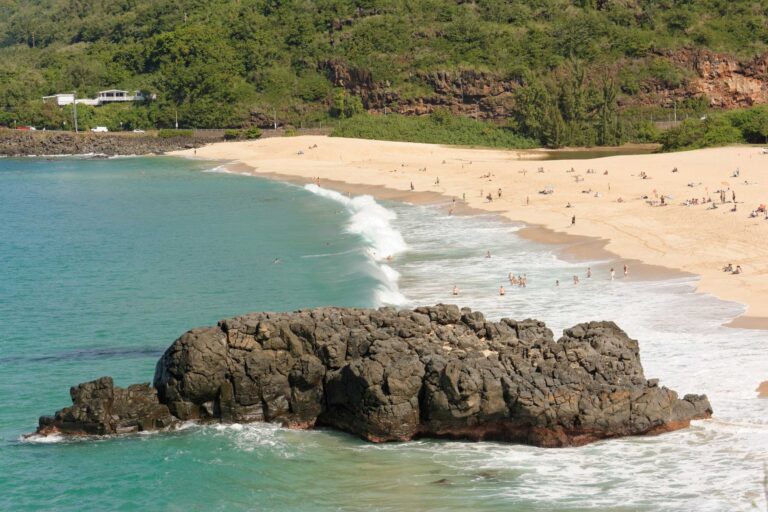
HawaiiBeachSafety.com lists snorkeling among the activities here, and the same page lists sharp coral and jellyfish as hazards. Summer, when the State calls North Shore waves flat to small, is the season to consider it, and only after Tower 29 says the water is fine that day. The City’s public service announcements include “Snorkel With a Buddy” (City Emergency Services). We did not find an official source ranking the snorkeling here, so for a North Shore spot with its own guide see Shark’s Cove or, for turtles on the sand, Turtle Beach.

Small-Group North Shore Day: Waimea Valley, Haleiwa and Turtle Snorkeling
★★★★★ 4.9 · 2,067 reviews · From $168
Check AvailabilityWe may earn a commission if you book through this link, at no extra cost to you.
Restrooms, Showers and Picnic Space
HawaiiBeachSafety.com lists restrooms, showers and a picnic area at the park (HawaiiBeachSafety.com); we found no official page that counts them or reports their condition. The park is closed from 10 p.m. to 5 a.m. (City park-closure hours). For lunch after the beach, our North Shore food truck guide has the shrimp trucks and the rest.
Getting There and Parking
Driving: Waimea Bay is about 39 miles from Waikīkī, roughly an hour without traffic by our OSRM count, and the highway slows on big-surf days. Our renting a car guide has the booking side.
Parking: neither the City nor the State publishes a stall count or a fill time for the lot. Hawaiʻi Public Radio lists “horrible parking” among the things the bay is known for (HPR). On the shoulders, the State Department of Transportation’s notice for the Eddie Aikau Big Wave Invitational on December 22, 2024, banned parking on both sides of Kamehameha Highway from ʻIliʻohu Place to the Mission of Saints Peter and Paul Church, said Honolulu police would patrol it, and said cars would be cited or towed at the owner’s expense (HDOT notice). That was one event, not every day; on any day, park only where the signs allow.
TheBus: Route 60 stops at Kamehameha Highway and Waimea Valley Road (TheBus schedule data). It does not start in Waikīkī; you ride to Ala Moana first. By our count of the schedule data, the weekday run from Kona Street in Honolulu to the Waimea Valley Road stop is about 2.5 hours, so plan on most of a day each way from Waikīkī.
Rental car
Waimea Bay is a drive-to beach
TheBus takes hours from Waikīkī, and the beaches along Kamehameha Highway are simplest by car. Compare Oahu rental cars on DiscoverCars.
We may earn a commission if you book through this link, at no extra cost to you.
Rules
HawaiiBeachSafety.com lists these prohibitions for the park: alcohol, amplified music, camping, diving, dogs, drones, fire pits and smoking (HawaiiBeachSafety.com). The City closes the park from 10 p.m. to 5 a.m. (City).
Nearby on the North Shore
The whole coast is in our North Shore guide. The next beach up the highway is covered in our Banzai Pipeline guide, and the rest of the island is in things to do on Oahu.
Waimea Bay Beach Park: Questions
What are Waimea Bay Beach Park’s hours?
The City closes the park from 10 p.m. to 5 a.m., so it is open 5 a.m. to 10 p.m. Lifeguard Tower 29 is staffed 8 a.m. to 6:30 p.m. daily.
Can you swim at Waimea Bay?
Swimming is listed among the park’s activities, and in summer the State calls North Shore waves flat to small. Shorebreak and currents still apply, so swim by Tower 29. In winter the State says swimmers of any skill level should avoid the water at these beaches during high surf.
Why are Waimea Bay’s waves so big in winter?
Winter swells from major storms far to the northwest reach Hawaii with no continental shelf to slow them, and off Waimea’s northeast point the seafloor rises abruptly, so the swell stands up into steep, plunging waves. The City has logged faces up to 30 feet there.
Can you jump off the rock at Waimea Bay?
The City publishes a safety announcement on the dangers of jumping from it, and the 2020 closure was tied to the COVID-19 emergency. We found no current rule by name, so follow the posted signs and ask the lifeguard.
Is there a lifeguard at Waimea Bay?
Yes. Tower 29 is open 8 a.m. to 6:30 p.m. daily, and the City posts tower closures on hnl.info.
Where do you park at Waimea Bay?
In the beach park lot or where roadside signs allow. We found no official stall count, and the State banned shoulder parking for the December 2024 Eddie Aikau event.
Can you bring a dog to Waimea Bay Beach Park?
No. HawaiiBeachSafety.com lists dogs among the park’s prohibitions.
Sources, checked Oct 27, 2026
- Lifeguard tower locations and hours (Honolulu Ocean Safety)
- Park closure hours (City DPR)
- Honolulu Ocean Safety history
- List of lifeguarded beaches (Hawaii Ocean Safety)
- Hawaii’s surf seasons (Hawaii Ocean Safety)
- Ocean hazards: dangerous shorebreak (Hawaii Ocean Safety)
- Ocean hazards: strong currents (Hawaii Ocean Safety)
- Waimea Bay Beach Park conditions page (HawaiiBeachSafety.com)
- Surf forecast (National Weather Service Honolulu)
- High surf advisory and warning criteria (National Weather Service Honolulu)
- Staying safe on Oahu (Honolulu Emergency Services Department)
- Ocean Safety rescues 32 on the North Shore (HESD, Nov 13, 2022)
- Second day of the new year (HESD, Jan 2, 2023)
- Waimea Rock closing (DLNR, Aug 15, 2020)
- Warning signs at the rock (DLNR, Aug 16, 2020)
- Waimea Bay lifeguard profile (Hawaiʻi Public Radio, Oct 7, 2025)
- Parking restricted for the Eddie Aikau Big Wave Invitational (HDOT notice, Dec 2024)
- TheBus GTFS schedule data (feed from Aug 9, 2026)
- Destructive high surf event, Nov 2003 (National Weather Service Honolulu)
- Weird Science: Extreme Surf (University of Hawaiʻi, Exploring Our Fluid Earth, 2011)
- Caldwell and Aucan, surf heights on Oahu’s north shore (Journal of Coastal Research 23(5), 2007)
- Why surf heights in Hawaii vary (Pat Caldwell, UH Sea Level Center)
- Goddard-Caldwell surf observations and the Hawaii scale (NOAA NCEI Accession 0001754)
- Coastal elevation models, CUDEM seafloor depths (NOAA NCEI)
- Coastal hazard message, Jan 2, 2023 (NWS Honolulu, via the Iowa Environmental Mesonet archive)
- Dangerous surf sends 2 people to the hospital (Star-Advertiser, Oct 8, 2012)
- Monster swell slowly dropping (Hawaii News Now, Nov 2018)
Researched from the sources above, checked Oct 27, 2026. We never claim a visit we did not make; first-hand notes are marked as Stew’s. How we research and review.

Leave a Reply