
North Shore · Walking Tour
Haleiwa Town: A Self-Guided Walk
Haleiwa town fits a plantation-era main street, a 1921 bridge, a missionary church and a Hawaiian fishpond inside two miles. This self-guided loop covers eight stops and the best things to do in Haleiwa on foot.
Route by OSRM foot routing on OpenStreetMap data, © OpenStreetMap contributors (ODbL).
Some links on this page are affiliate links. If you book or buy through them, we may earn a commission at no extra cost to you.
On August 5, 1899, the Haleiwa Hotel opened for the railroad’s passengers.
Benjamin Dillingham’s Oahu Railway and Land Company ran the trains, and it built the hotel as somewhere for them to go. It is the reason this stretch of coast turned into a visitor town. Most guests arrived by rail, to two stories of wide verandas under striped awnings.
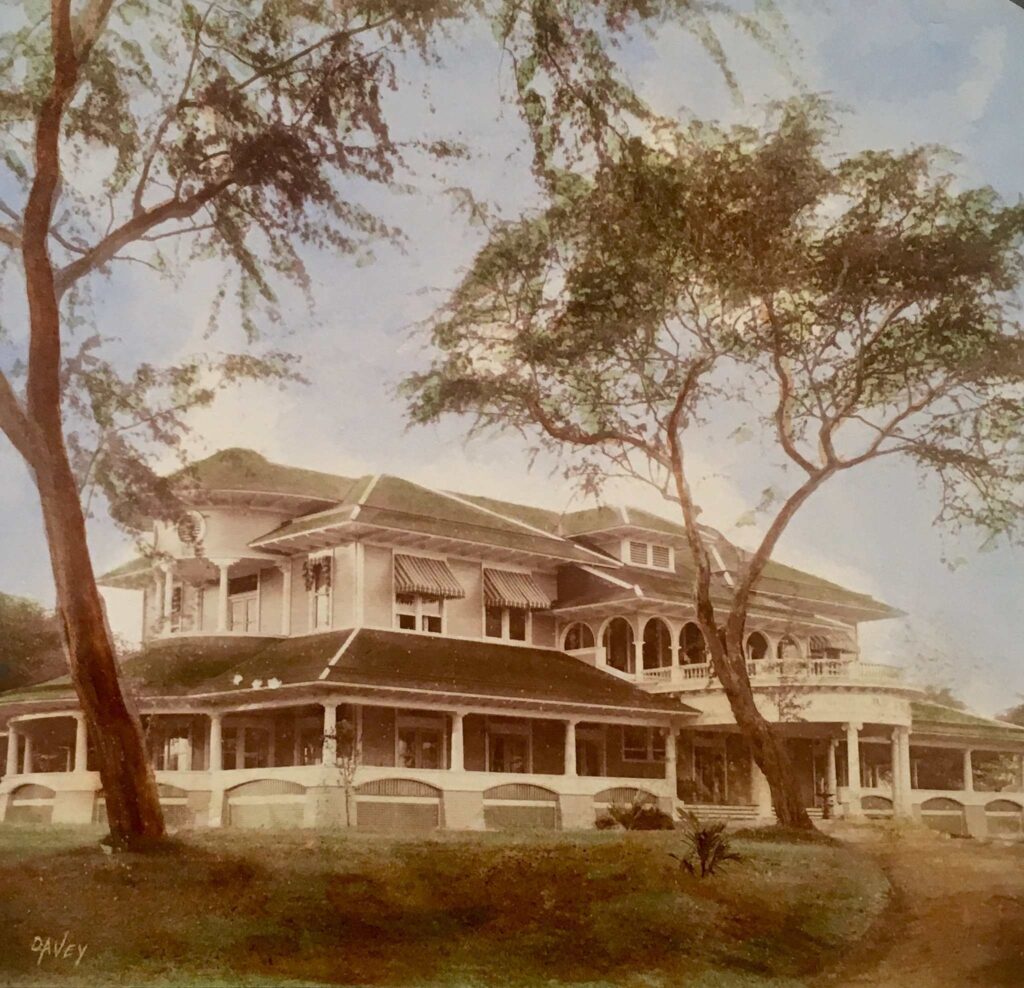
The hotel came down in the early 1950s. The North Shore Chamber of Commerce has been fixing bronze plaques to the old buildings, so look for them as you go, and its visitor center at the south end of town hands out a printed walking tour brochure.
This Haleiwa walking tour runs eight stops, flat, about two miles. Allow two hours with a shave ice stop, or one hour if you turn back after the fishpond. A spur west along Haleiwa Road adds the boat harbor, a beach park, a Buddhist temple and a 1932 fire station.
On March 20, 2026, a Kona low storm flooded Haleiwa and Waialua. Shops and restaurants had reopened by the end of that month, and they want visitors back; local reporting in May described recovery as slow.
Getting There and Parking
Start at Haleiwa Store Lots, 66-111 Kamehameha Highway, on the south side of the bridge. The center lists 95 parking stalls, and stop 1 is in its buildings. The toilets inside the center are marked for patrons only on the chamber’s restroom map; the public restrooms on the loop are at Haleiwa Beach Park, stop 7.
The other good start is Haleiwa Beach Park at the north end of town, which has parking, restrooms and showers. Begin there and walk the loop in reverse.
- By car. The Oahu Scenic Drive Map plots the drive to Haleiwa and the coast beyond it, and the North Shore Oahu guide covers the rest of the shore.
- By bus. TheBus route 60 (Honolulu, Kaneohe, Haleiwa) stops at the courthouse, Lokoea Place and Haleiwa Beach Park, all on this loop; route 52 (Honolulu, Mililani, Haleiwa) stops at Lokoea Place and the beach park.
- On foot. Most of the route follows Kamehameha Highway, a two-lane road through town, with short side trips onto side streets. It is flat the whole way.
Rental Cars
Rent a Car for the North Shore
The walk needs no car, but one lets you add the Waialua Sugar Mill, 2.4 miles away, and the North Shore beaches on the same day.
We may earn a commission if you book through this link, at no extra cost to you.
The Haleiwa Walking Tour: 8 Stops
The numbers match the map above. Stops 1 and 2 sit around Haleiwa Store Lots; stops 3 to 6 cluster at the bridge; stop 7 is the turnaround at the beach; stop 8 is on the way back to the lot.
Matsumoto Store and the Yoshida Buildings
Start with the two buildings that look carved from sugar. The Yoshida twins went up in 1923, built by Nosaka Contractors for Matsuji and Hatsune Yoshida out of hand-cut lava blocks. The street faces are plastered smooth; the sides are bare stone. When Kamehameha Schools rebuilt Haleiwa Store Lots, finished in 2016, it kept them.
A few steps away is the wood-frame store from about 1904 where Sego and Tayo Tanaka ran a tailor and dry goods shop. Mamoru and Helen Matsumoto took it over and opened Matsumoto Grocery there on February 13, 1951.
Five years later they began selling shave ice from a hand-cranked machine from Japan that they fitted with a motor. Their son Stanley ran the shop from 1976.
The chamber’s bronze plaque is on the building. Matsumoto is open daily 10 a.m. to 6 p.m. (closed Thanksgiving, December 25 and January 1); the Matsumoto Shave Ice review has the menu and what to order.
Liliʻuokalani Protestant Church
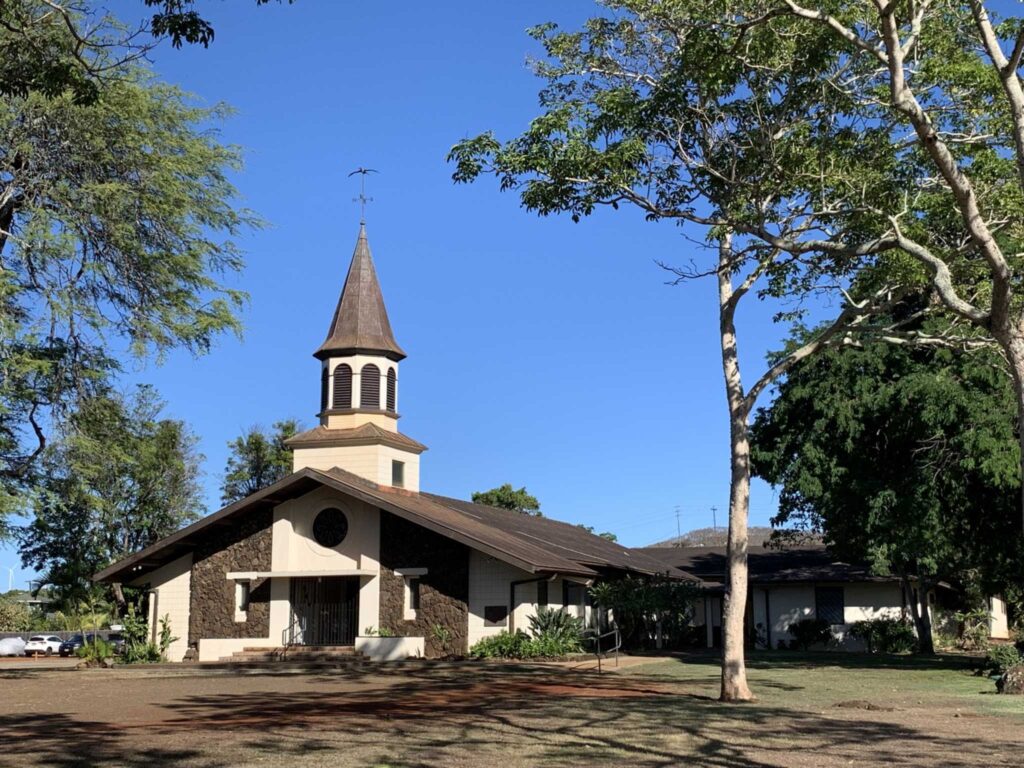
In 1832 the missionaries John and Ursula Emerson, helped by High Chief Gideon Laʻanui, started a church near the mouth of Anahulu Stream on Waialua Bay. By 1841 an adobe church stood where the cemetery is now.
The third church, built of wood in 1890, used lumber donated by Queen Liliʻuokalani. She also gave hymnals, chandeliers and a wall clock.
The clock has no numerals. The twelve letters of her name stand in for the hours.
The building in front of you is the fourth. Theodore Vierra designed it, Erica Karawina made the stained glass, rose window included, and it was dedicated in June 1961. The ʻiwa-bird weathervane on the steeple went up in 1985. This is a working church with Sunday worship at 10 a.m.; look from the street.
Haleiwa Hotel Site
This corner, where Haleiwa Road leaves the highway, is the hotel site: the Oahu Railway and Land Company’s Haleiwa Hotel from the intro stood here.
It was torn down in the early 1950s.
The site later held the Sea View Inn (1955), the Chart House (1989) and now Haleiwa Joe’s, which opens for dinner nightly from 4:30 to 9.
Haleiwa Road heads west from here, the start of the optional spur below.
Rainbow Bridge
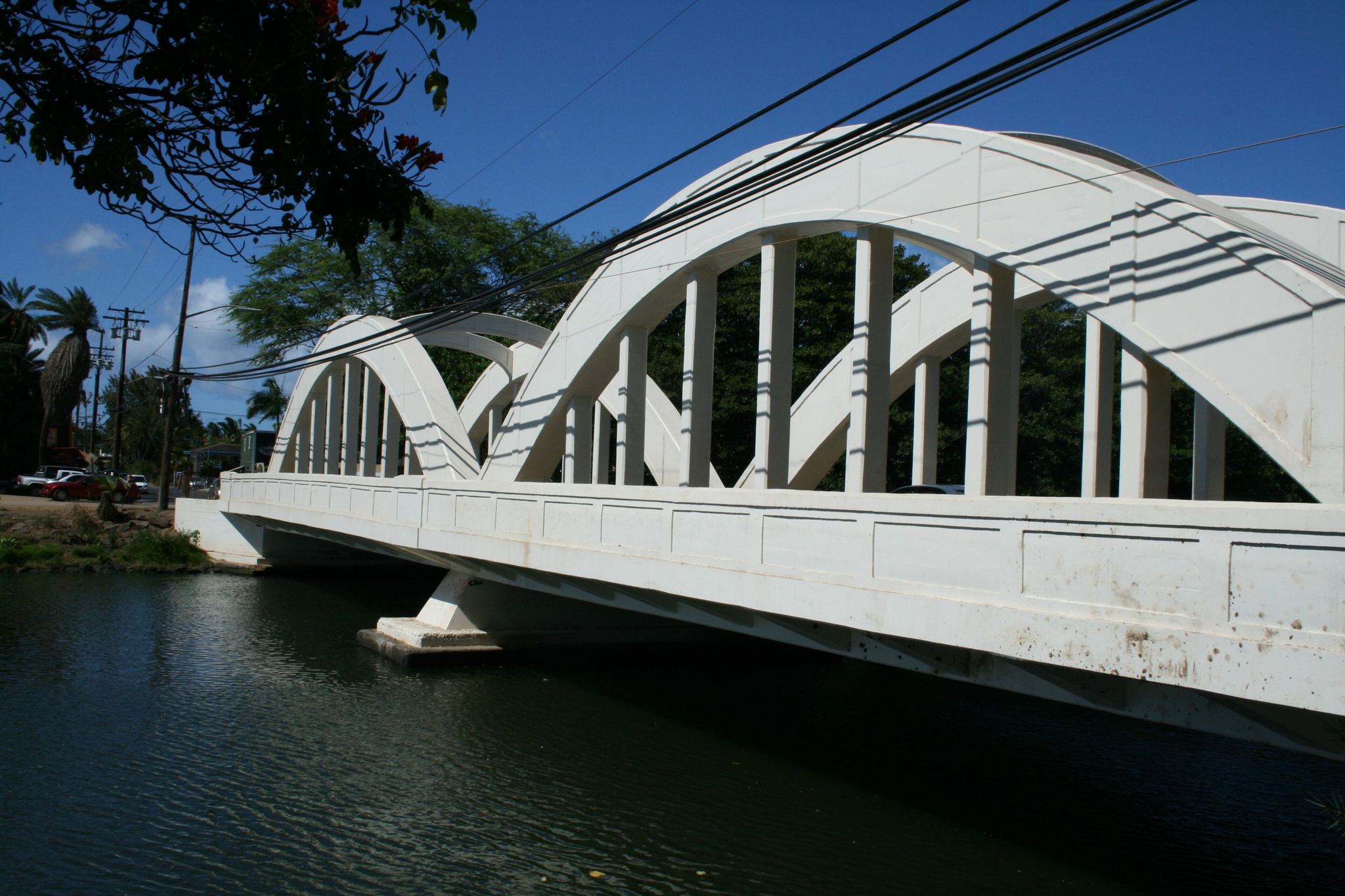
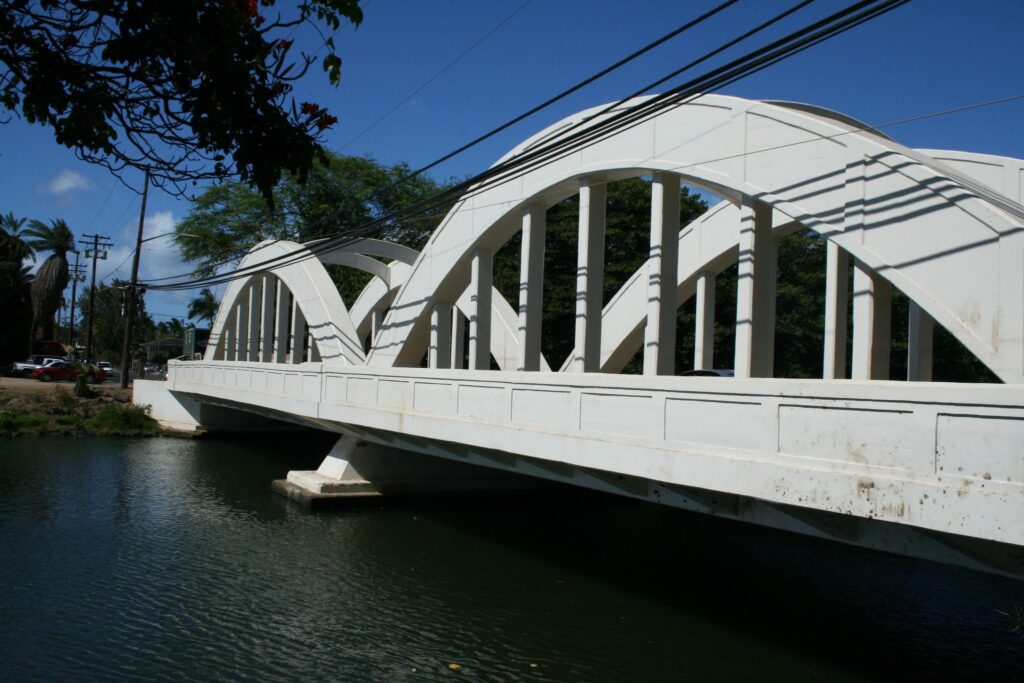
The double arches are the town’s postcard. They replaced a wooden bridge in 1921: the Anahulu Stream Bridge, designed by engineer Fred Ohrt and architect Guy Rothwell. Historic Hawaiʻi Foundation counts it as one of only two bridges of its type left in Hawaii.
To the city it is Kamehameha Highway Bridge No. 603. A rehabilitation began on April 29, 2024: concrete repair, corrosion-control anodes and new paint, with the work closing one sidewalk at a time. From the north bank, Surf N Sea is the next building.
Surf N Sea
The yellow-and-brown building at the north end of the bridge dates to 1921 and began as a general store. In the early 1930s the Miura family ran a dry goods and tailor shop here and lived upstairs. The Ochiai family followed with a grocery until 1944.
They kept a light burning upstairs for the sampans moored in the stream.
The Liskey family opened Surf N Sea in the mid-1960s, selling hardware, guns, ammunition and dive gear. Joe Green’s family runs it now, and Historic Hawaiʻi Foundation calls it the longest-running surf shop in Hawaii. The foundation also notes remnants of the Oahu Railway and Land Company line on the ocean side of the building.
Loko Ea Fishpond
Loko Ea is a Hawaiian fishpond in the Kawailoa ahupuaʻa. Mālama Loko Ea Foundation has cared for it since 2009 on Kamehameha Schools land, and its executive director has called it a 400-year-old pond.
The Hawaiian historian Samuel Kamakau listed its mullet among the choice foods of the chief Kākuhihewa’s childhood. Historic Hawaiʻi Foundation records that it was later a summer retreat of Queen Liliʻuokalani, the same queen whose name is on the church clock.
The foundation calls it a sacred space and runs it as a working site, not a park. The way in is a community workday: the third Saturday of each month, 9 a.m. to noon, with lunch provided (November 21 and December 19 in 2026). Register on lokoea.org, and wear clothes you do not mind getting wet and muddy.
Haleiwa Beach Park
The turnaround, and the halfway rest stop. This 12.7-acre park was built in 1939, during the years the city was putting up its Art Deco parks. A poured-concrete wall runs along the highway with lawns and a pavilion behind it; Historic Hawaiʻi Foundation credits the design to architect Harry Sims Bent, and the park is part of the city’s Art Deco Parks and Playgrounds listing.
It has the public restrooms and showers on the loop, plus parking and a bus stop. From here the walk heads back south on Kamehameha Highway. The return retraces the main street, so cross at a crosswalk and take the other side back.
Waialua Courthouse
The Waialua Courthouse went up in 1913: wood frame, T-shaped, Neo-Classical Revival, with deep eaves against the sun and stone footings. Over the years it served the Waialua District as a post office, a health center, a courtroom and a jail; the jail cells were in the basement under the single story.
It has been on the state’s historic register since 1979, and the Office of Hawaiian Affairs has held the 1.06-acre property under a state lease since 1998. There are no published public hours, so this one is an exterior stop. The Store Lots lot is about 0.2 miles south.

Oahu: Full or Half Day Grand Circle Island Tour
★★★★★ 5.0 · 19,733 reviews · From $100
Check AvailabilityWe may earn a commission if you book through this link, at no extra cost to you.
Without a car or a free afternoon, a circle island tour is the other way in. This one circles Oahu, and its full-day itinerary gives Haleiwa town a 90-minute stop for lunch and shopping: enough for stops 1 to 5 at a brisk pace.
Add the West Spur on Haleiwa Road
From the hotel corner at stop 3, Haleiwa Road runs west past the harbor to the Buddhist temple, about 0.6 miles each way, and the fire station is a quarter mile beyond (about 1.7 miles there and back in all). Walk it out and back before you cross the bridge, and allow another hour.
Haleiwa Boat Harbor
Work on the breakwater began in 1955; the bulkhead walls and slips were finished in 1968. The harbor runs along the road about 0.1 to 0.2 miles from the hotel corner.
Haleiwa Aliʻi Beach Park
The beach park just west of the harbor has lifeguards daily from 8 a.m. to 6:30 p.m. on the state’s ocean safety list, plus restrooms, parking and a bus stop. The North Shore waves guide covers which North Shore beaches break when.
Haleiwa Jodo Mission
Reverend Muroyama came over from Kauai to start the first Jodo temple on Oahu, drawn by the Japanese plantation workers around Waialua. At the end of 1913 the mission bought the old Waialua Hotel, known as the Ocean House at Waialua, for $12,000, converted it into a temple, and took the Haleiwa name the same year.
The temple in use today dates to 1975. On November 22, 2019, the Hawaii Historic Places Review Board voted 8 to 0 to list it on the Hawaii Register and recommend it to the National Register. It is a private religious site: look from the street.
Waialua Fire Station
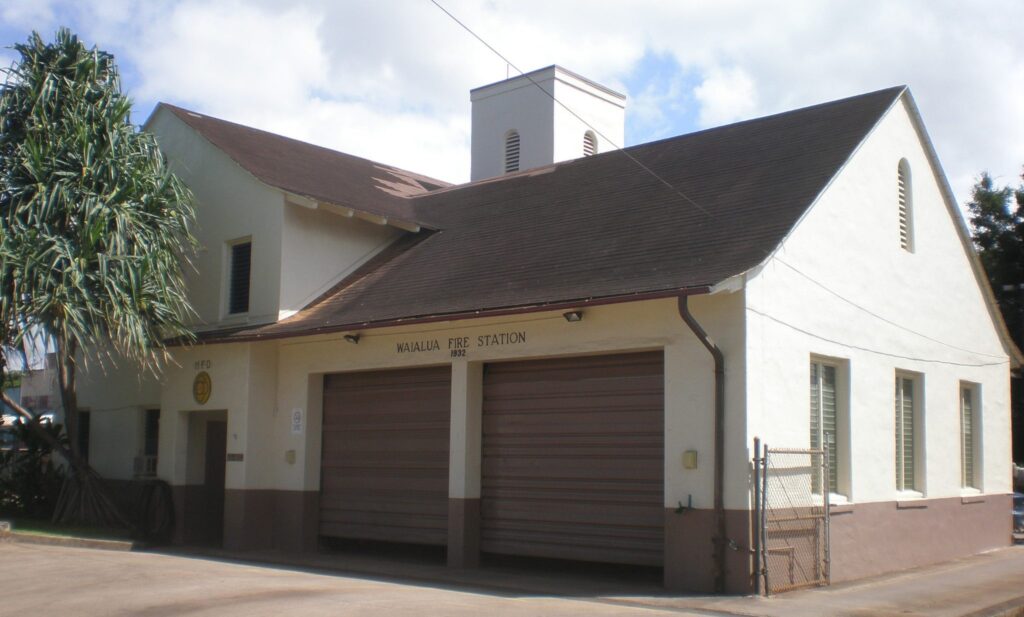
About a quarter mile past the temple, the 1932 station in Mission and Spanish Revival style was designed by A. W. Heen and listed on the National Register on December 2, 1980. It is still Honolulu Fire Station 14. The March 2026 flood damaged it, and its crews were out for weeks before returning home in early April.
Exterior only, and keep clear of the apron in front of the bay doors: the engines still roll out of them.
Where to Eat on the Walk
Three places on the route publish their hours.
- Shave ice. Matsumoto at stop 1, daily 10 a.m. to 6 p.m. Aoki’s faces it across the highway if the line is long.
- Coffee and breakfast. Island Vintage Coffee is in Haleiwa Store Lots, across from Matsumoto: daily 7 a.m. to 5 p.m., with the kitchen open until 2 p.m.
- Dinner. Haleiwa Joe’s on the hotel site at stop 3 opens nightly from 4:30 to 9 p.m. and serves lunch Friday to Sunday from 11 a.m., so plan the walk for the afternoon and finish there.
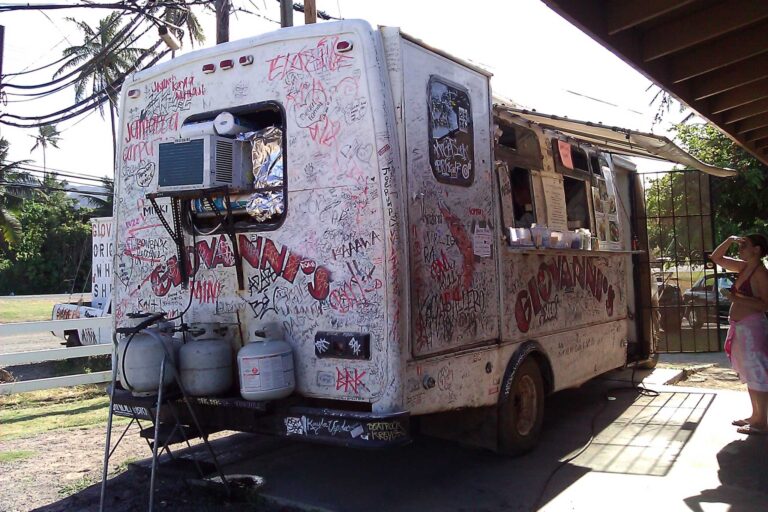
- Lunch from a truck. The North Shore food trucks guide covers the trucks in Haleiwa and on up the coast to Kahuku.
By Car: Waialua Sugar Mill
Castle and Cooke formed the Waialua Agricultural Company in 1898 and had a new mill built by the end of that year. Sugar ended there in October 1996, the last plantation on Oahu to close.
Island X Hawaii, in the old mill complex at 67-106 Kealohanui Street, says its staff give visitors a quick tour of the Waialua coffee mill. It is 2.4 miles from Haleiwa Store Lots on foot, so drive or bike it, and call ahead for hours.
Haleiwa Town Questions
How long is the Haleiwa walking tour?
The eight-stop loop is about 2 miles (3.2 km) from Haleiwa Store Lots and back, roughly 45 minutes of walking by OpenStreetMap foot routing. Plan about two hours with a shave ice stop. For a one-hour version, walk stops 1 to 6 and come back: about 1.1 miles. The Haleiwa Road spur adds about 1.2 miles there and back to the temple, or about 1.7 miles with the fire station.
Where do you park for the walk?
Start at Haleiwa Store Lots, 66-111 Kamehameha Highway, which lists 95 parking stalls. Haleiwa Beach Park at the north end of town also has parking; start there and walk the loop in reverse.
Is the walk good for kids?
The route is flat and mostly follows Kamehameha Highway, a two-lane road through town, so keep small children close. The public restrooms on the loop are at Haleiwa Beach Park, stop 7, about halfway round.
Can you visit Loko Ea fishpond?
Loko Ea is a working fishpond cared for by Mālama Loko Ea Foundation, not a park. The way in is a community workday on the third Saturday of the month, 9 a.m. to noon; the foundation asks you to wear clothes you do not mind getting wet and muddy.
What is the Rainbow Bridge in Haleiwa?
It is the Anahulu Stream Bridge, a double-arched concrete bridge that carries Kamehameha Highway into town. It was built in 1921, and Historic Hawaiʻi Foundation counts it as one of only two bridges of its type left in Hawaii.
Leave a Reply